HonestMOS
InvestigationsCongress made VA disability claims free to file. An entire industry charges veterans anyway — and nobody can stop them.
Navy Career Guides

Navy Ranks Explained: Pay Grade, Rating, and Reality

Honest MOS Editorial

Every U.S. Navy rank from SR (Seaman Recruit) to FADM (Fleet Admiral) — with 2026 DFAS base pay, real time-in-rate timelines, the rating system, and the on-paper-vs-reality breakdown of every paygrade. Includes the Chief Mess, the Triad, the Coner-vs-Nuke divide, and what your recruiter will not actually explain about anchors and crows.

Future SailorsActive dutyVeteransRecruiters (off the record)Civilians decoding LinkedIn

Pay reflects 2026 DFAS projected base pay tables effective January 1, 2026. Time-in-rate and selection timelines are published by Navy Personnel Command (NAVADMIN series) and reflect typical advancement, not promises. Always verify with NAVPERS, MyNavy HR, or your detailer. This guide is information, not policy.

23+
Paygrades
E-1 → ADM (+ FADM in wartime)
9
Enlisted Grades
SR through MCPON
4
Warrant Grades
CWO2 through CWO5
10
Officer Grades
ENS through ADM
~11-15 yr
E-1 → Chief
typical timeline to E-7
Oct 13
Navy Birthday
Chief pinning day
The Thesis

The Navy has two rank systems and you need to understand both.

The first is the joint paygrade system: E-1 through E-9, W-2 through W-5, and O-1 through O-10. This is the system DFAS uses to write checks and the system every other service shares. The second is the Navy’s own internal language: SN, PO3, PO2, PO1, CPO, SCPO, MCPO, ENS, LTJG, LT, LCDR, CDR, CAPT — combined with a Sailor’s rating (their job designator like BM, OS, IT, MM) to form their full rate.

A Sailor is never called “Petty Officer Jones” in actual conversation. They are “OS2 Jones” — Operations Specialist Second Class Jones. The paygrade is just the back half. The rating is the front half. Together they are a rate, and the rate is the identity. This is why on a recruiting poster you will see “Cryptologic Technician” before you ever see “Petty Officer.”

The reality on a Navy ship is also that the formal rank structure is one of three power structures aboard. The other two: the Chief Mess (sacred, parallel, often decisive), and the warfare-community network (SWO/aviator/submariner/spec-ops, each with its own institutional memory). Anyone who has spent three months on a deployed warship can tell you which one is running the day at any given moment. This guide covers all three.

Section 01 — Quick Reference

All Navy ranks at a glance

Every paygrade, the rate or rank name, the abbreviation, the insignia, 2026 DFAS base pay at entry and at a typical years-of-service for that grade, and the realistic time to reach this paygrade from E-1 (enlisted) or commissioning (officer).

PaygradeRank / RateAbbrInsigniaBase <2 yrsTypical payTime to reach
E-1
Seaman Recruit
Junior Enlisted
SR
No insignia (smooth sleeve)
$2,038
$2,038
flat across all YOS
Entry — boot camp at RTC Great Lakes
E-2
Seaman Apprentice
Junior Enlisted
SA
US Navy Seaman Apprentice (E-2) insigniaTwo diagonal stripes (white on blue, blue on white) on left sleeve
$2,284
$2,284
flat across all YOS
~9 months from E-1 (automatic if proficient)
E-3
Seaman / Airman / Fireman / Constructionman / Hospitalman / Dentalman
Junior Enlisted
SN / AN / FN / CN / HN / DN
US Navy Seaman / Airman / Fireman / Constructionman / Hospitalman / Dentalman (E-3) insigniaThree diagonal stripes (group rate stripe color varies: white/red/green/blue)
$2,402
$2,706
3+ yrs
~12–24 months from E-1
E-4
Petty Officer Third Class
Petty Officer
PO3
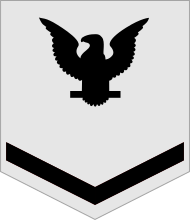
US Navy Petty Officer Third Class (E-4) insigniaEagle perched on single chevron + rating specialty mark — first "crow"
$2,661
$3,214
6+ yrs
~2.5–3 yrs from E-1 (passes E-4 advancement exam)
E-5
Petty Officer Second Class
Petty Officer
PO2
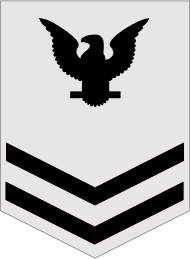
US Navy Petty Officer Second Class (E-5) insigniaEagle + two chevrons + rating mark
$2,903
$3,846
12+ yrs
~4–5 yrs from E-1
E-6
Petty Officer First Class
Petty Officer
PO1
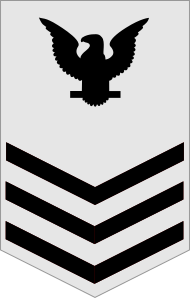
US Navy Petty Officer First Class (E-6) insigniaEagle + three chevrons + rating mark
$3,167
$4,720
20+ yrs
~7–10 yrs from E-1
E-7
Chief Petty Officer
Chief Mess
CPO / Chief
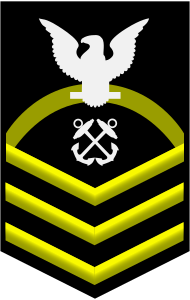
US Navy Chief Petty Officer (E-7) insigniaFouled anchor (the anchor) with "USN" — khaki uniform unlocked
$3,661
$5,711
24+ yrs
~11–15 yrs from E-1 (selection board, not just exam)
E-8
Senior Chief Petty Officer
Chief Mess
SCPO / Senior
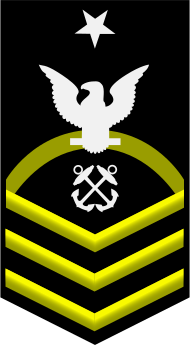
US Navy Senior Chief Petty Officer (E-8) insigniaFouled anchor topped with one silver star
$5,245
$6,507
26+ yrs
~16–20 yrs from E-1
E-9
Master Chief Petty Officer
Chief Mess
MCPO / Master
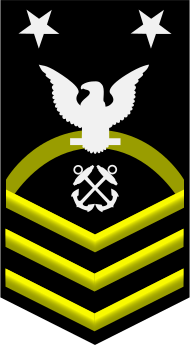
US Navy Master Chief Petty Officer (E-9) insigniaFouled anchor topped with two silver stars
$6,620
$8,169
26+ yrs
~20–24 yrs from E-1
W-2
Chief Warrant Officer 2
Warrant Officer
CWO2
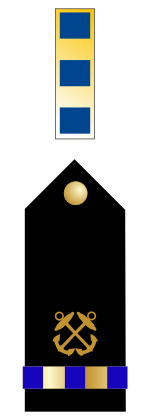
US Navy Chief Warrant Officer 2 (W-2) insigniaGold bar with three blue breaks
$4,301
$6,726
20+ yrs
Entry into Navy WO program (typically from senior enlisted, E-6+)
W-3
Chief Warrant Officer 3
Warrant Officer
CWO3
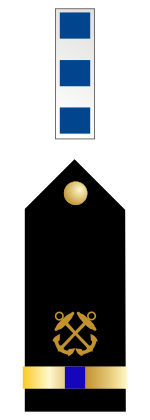
US Navy Chief Warrant Officer 3 (W-3) insigniaGold bar with two blue breaks
$4,868
$7,757
24+ yrs
~4–6 yrs after CWO2
W-4
Chief Warrant Officer 4
Warrant Officer
CWO4
US Navy Chief Warrant Officer 4 (W-4) insigniaGold bar with one blue break
$5,325
$8,891
26+ yrs
~10–12 yrs after CWO2
W-5
Chief Warrant Officer 5
Warrant Officer
CWO5
US Navy Chief Warrant Officer 5 (W-5) insigniaGold bar with single blue stripe down center
$9,375
$10,555
30+ yrs
Senior warrant — by-name selection, very limited billets
O-1
Ensign
Junior Officer
ENS
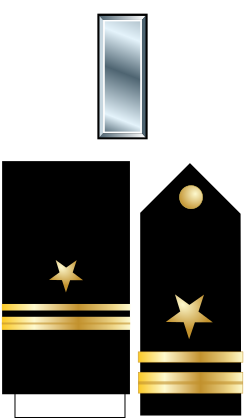
US Navy Ensign (O-1) insigniaSingle gold bar (collar/shoulder); 0.5" stripe on sleeve
$3,826
$4,960
6+ yrs
Entry via USNA, NROTC, OCS — commissioning
O-2
Lieutenant Junior Grade
Junior Officer
LTJG
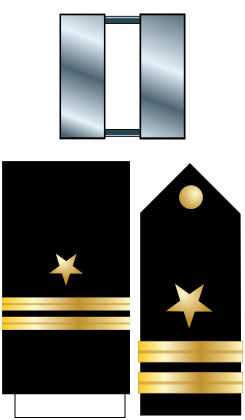
US Navy Lieutenant Junior Grade (O-2) insigniaSilver bar; 0.5" + 0.25" sleeve stripe
$4,407
$6,095
4+ yrs
~18 months from O-1 (essentially automatic with no adverse record)
O-3
Lieutenant
Junior Officer
LT
US Navy Lieutenant (O-3) insigniaTwo silver bars; two 0.5" sleeve stripes
$5,097
$8,393
14+ yrs
~4 yrs from commissioning
O-4
Lieutenant Commander
Senior Officer
LCDR
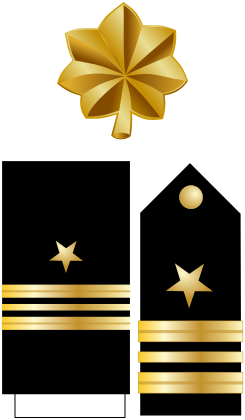
US Navy Lieutenant Commander (O-4) insigniaGold oak leaf; 0.5"+0.25"+0.5" sleeve stripes
$5,800
$9,497
20+ yrs
~10–11 yrs from commissioning (first competitive board)
O-5
Commander
Senior Officer
CDR
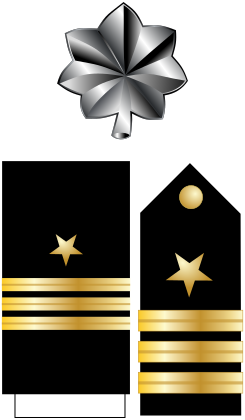
US Navy Commander (O-5) insigniaSilver oak leaf; three 0.5" sleeve stripes
$6,731
$11,174
22+ yrs
~15–17 yrs from commissioning
O-6
Captain
Senior Officer
CAPT
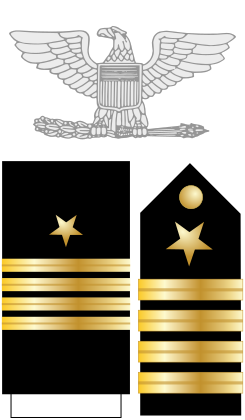
US Navy Captain (O-6) insigniaSilver eagle ("colonels" of the sea); four 0.5" sleeve stripes
$8,072
$14,076
30+ yrs
~21–23 yrs from commissioning
O-7
Rear Admiral (Lower Half)
Flag Officer
RDML
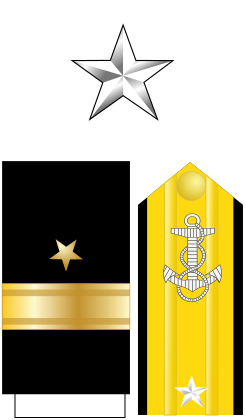
US Navy Rear Admiral (Lower Half) (O-7) insigniaOne silver star; one 2" sleeve stripe
$10,633
$14,159
20+ yrs
Flag selection — small board, by-name
O-8
Rear Admiral (Upper Half)
Flag Officer
RADM
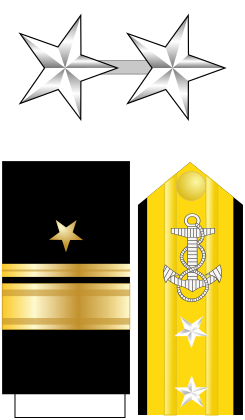
US Navy Rear Admiral (Upper Half) (O-8) insigniaTwo silver stars; one 2" + one 0.5" sleeve stripe
$12,836
$15,648
20+ yrs
~2–4 yrs after RDML
O-9
Vice Admiral
Flag Officer
VADM
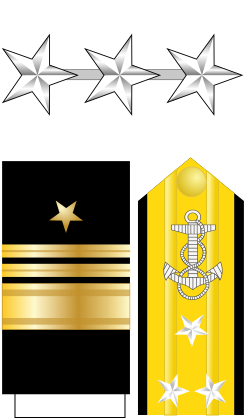
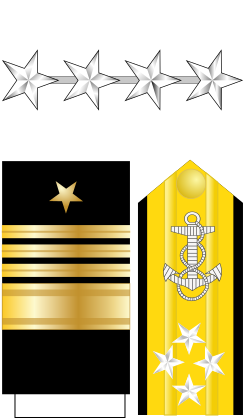
US Navy Vice Admiral (O-9) insigniaThree silver stars; one 2" + two 0.5" sleeve stripes
$16,667
$16,667
20+ yrs (capped)
Three-star — typically major fleet command or Pentagon billet
O-10
Admiral
Flag Officer
ADM
US Navy Admiral (O-10) insigniaFour silver stars; one 2" + three 0.5" sleeve stripes
$17,675
$17,675
20+ yrs (capped)
Four-star — CNO, Vice CNO, Combatant Commanders, Fleet Forces
O-11
Fleet Admiral
Fleet Admiral
FADM
Five gold stars in pentagon — wartime only
Last awarded December 1944 (Leahy, King, Nimitz, Halsey)

Source: 2026 DFAS projected basic pay tables (Title 37 USC §1009 increase applied uniformly across all services). Insignia descriptions reflect current Navy Uniform Regulations.

Section 02 — Enlisted (E-1 through E-9)

Crows, anchors, and the long climb to the Mess

The Navy’s enlisted force is roughly 270,000 Sailors at any given time. Most never make E-7 — the High Year Tenure system forces an exit at the 20-year mark if a Sailor has not advanced past E-6 by then. The Sailors who do make Chief, Senior, and Master Chief are the backbone of the Navy in a way the wardroom acknowledges privately and only sometimes publicly.

No insignia
E-1

Seaman Recruit

SR
On Paper

Most junior enlisted paygrade. Sailor in basic recruit training. Expected to learn Navy fundamentals, customs, and basic seamanship.

Reality

You exist at Recruit Training Command Great Lakes, the only Navy boot camp, and you do not have a name — you have a division number. Eight weeks of marching, classroom indoctrination, fire-fighting trainer, the Battle Stations 21 capstone, and somewhere in there you learn to fold a square knot into a tee shirt. The smooth sleeve is the mark. You will leave RTC as an E-1 unless you came in with college credits, JROTC, or the Delayed Entry Program bumped you up.

Culture

Old Navy saying: "There is the right way, the wrong way, and the Navy way." E-1 is when you learn that the Navy way is the only way that exists.

US Navy Seaman Apprentice (E-2) insignia
E-2

Seaman Apprentice

SA
On Paper

Promoted from E-1 after 9 months of satisfactory service (or graduation from "A" School). Beginning to specialize in a rating or in a "general apprenticeship" group (Seaman/Fireman/Airman/Constructionman/Hospitalman/Dentalman).

Reality

You have two stripes and a check at the end of the month. You are still cleaning. You are still standing watch you did not know existed (the messcook watch, the security watch, the petty officer of the watch on the quarterdeck at midnight). Your group rate (deck/engineering/aviation/Seabees/corpsman) starts to define what your daily life smells like — JP-5 for AN, bilge water for FN, the unmistakable smell of a 1MC at 0600 for SA.

US Navy Seaman (and group equivalents) (E-3) insignia
E-3

Seaman (and group equivalents)

SN
On Paper

Three stripes. Junior enlisted, expected to know your rate and to take initiative. Pre-petty officer track. SN/AN/FN/CN/HN/DN denote the apprenticeship community (Seaman, Airman, Fireman, Constructionman, Hospitalman, Dentalman).

Reality

You clean things. You clean more things. You step over an HMC napping in the head at 0300 because you have midwatch on the quarterdeck and the brow is still up. You learn what "field day" actually is — not a Friday picnic, but a 4-hour command-wide deep clean every week that you cannot escape. You start studying for the E-4 exam in your rack. Welcome to the Navy.

Culture

In aviation, "AN" makes you a "blueshirt" on a flight deck — color identifies your job at a glance. In engineering, "FN" means you are on the throttles and in the bilge. In medical, "HN" with USMC ground forces makes you "Doc" forever.

US Navy Petty Officer Third Class (E-4) insignia
E-4

Petty Officer Third Class

PO3
On Paper

First petty officer rank. NCO equivalent in other services. Earned by passing the Navy-Wide Advancement Exam (NWAE) plus quotas. Begins to wear "the crow" — the eagle perched on the chevron.

Reality

You "earned your crow" and the Mess will let you stand at the table when invited. You actually run a watchstation now — Helm and Lee Helm, RT3 on a radar, Reactor Operator under instruction for nukes, plane captain on the flight line. The "what the rate actually does" gap between, say, an OS3 in CIC and a CS3 in the galley is bigger than the gap between any other two paygrades in the Navy.

Career tip

The advancement exam is half rating knowledge, half PMK (Professional Military Knowledge). PMK questions are the easy points if you actually study them. Most sailors do not.

US Navy Petty Officer Second Class (E-5) insignia
E-5

Petty Officer Second Class

PO2
On Paper

Mid-grade petty officer. Work center supervisor for small shops. Senior watchstander. Eligible for E-5 exam after time-in-rate.

Reality

You are running the watch now and signing for things. On a destroyer, the OS2 is a CIC watch supervisor running an entire piece of the air picture. On a sub, the MM2 is a Throttleman and a senior reactor watchstander. On a carrier, the AD2 is plane captain on a jet you cannot afford and signing the yellow sheet. You are also writing your own evals and probably evals for the SN you supervise.

Culture

On a small ship (DDG, FFG, LCS), PO2s carry actual operational weight. On a carrier, PO2s are a layer of the org chart. Same paygrade, two different careers.

US Navy Petty Officer First Class (E-6) insignia
E-6

Petty Officer First Class

PO1
On Paper

Senior petty officer. Leading Petty Officer (LPO) for divisions. Eligible to test for E-7 (Chief) once enough TIR is in.

Reality

PO1 is the most consequential paygrade in the Navy that nobody outside the lifeline understands. You are the LPO running the division while the Chief is in the Mess, the DivO is "in a meeting," and the Department Head is signing two-deck-down. If you are good, the wardroom asks you when something breaks before they ask the Chief. If you are great, you make Chief and discover the next caste system.

Career tip

"Make Chief or get out" is the unspoken rule. PO1s who fail to select after multiple looks are very rarely retained past 20 — High Year Tenure forces the door.

US Navy Chief Petty Officer (E-7) insignia
E-7

Chief Petty Officer

CPO
On Paper

Senior enlisted leader. Advises the wardroom (officers). Mentors junior enlisted. Selected by a board of senior chiefs and master chiefs — not just by exam.

Reality

GOD. The Khaki Mafia. Whatever the Chiefs decide is what is actually happening on the ship. The wardroom thinks they run the boat — the Chiefs actually do. They control the Plan of the Day at the deck-plate level, they decide who gets the good orders and who gets the gapped billet in Bahrain, and they enforce the standards. The pinning is a 6-week initiation ("CPO Season") that culminates on the Navy birthday — September into October — and is documented internally as legitimate Navy tradition.

Culture

"The Mess is the Mess." Chiefs eat together, deck-plate together, and protect each other. They are also brutal on their own. CPOs call each other by first name in the Mess and "Chief" everywhere else. The day you make Chief is the day you stop being part of the rest of the enlisted force — you are now Khaki, and the distance is real.

US Navy Senior Chief Petty Officer (E-8) insignia
E-8

Senior Chief Petty Officer

SCPO
On Paper

Senior advisor at the department level. Often Department LCPO. Promotion is competitive, not automatic.

Reality

Senior is the technical master in the department. The Chief still owns the deck-plate; Senior owns the long-game — manning, training, qualifications, the inspection prep that lasts 18 months. On most ships there are far fewer Seniors than Chiefs, and they carry more institutional memory than anyone in khakis or stripes.

US Navy Master Chief Petty Officer (E-9) insignia
E-9

Master Chief Petty Officer

MCPO
On Paper

Senior enlisted advisor at the command level. Master in the rating. Often Command Master Chief at the unit level.

Reality

Master Chiefs are the institution. A good Master Chief makes the difference between a "good ship" and a "broken ship" — every Sailor on board can name them. There are command-rating Master Chiefs (e.g., the senior IT Master Chief at NAVIFOR) who set Navy-wide policy in their community.

Culture

"You can outrank a Master Chief. You cannot outrank his experience." — a saying every LT has heard from a CO at some point.

No insignia
E-9 (special billet)

Command Master Chief

CMC
On Paper

Command-level senior enlisted leader. Member of the "Triad" with the Commanding Officer and Executive Officer. Provides unfiltered enlisted perspective directly to the CO.

Reality

The CMC is the only enlisted Sailor on board with direct, no-knock access to the CO. A weak CMC is invisible; a strong CMC re-shapes the entire command. The CMC wears the same anchors and stars as any other Master Chief but the badge that says "CMC/CMDCM" makes them the chief Chief.

No insignia
E-9 (single billet)

Master Chief Petty Officer of the Navy

MCPON
On Paper

Single-incumbent senior enlisted leader of the U.S. Navy. Advises the Chief of Naval Operations (CNO) and the Secretary of the Navy on all enlisted matters. Selected by the CNO. The 17th MCPON, James Honea, assumed the post on September 8, 2022.

Reality

One Sailor in the entire Navy. Wears unique sleeve insignia (gold star between the anchors and crow). Travels constantly, testifies before Congress, and signs his name to the cultural direction of the enlisted force.

Section 03 — Warrant Officers (CWO2 through CWO5)

The technical commissioned track the Navy almost abolished

The Navy effectively shut down its warrant officer program in the late 1990s, relying instead on Limited Duty Officers (LDOs) for technical commissioned billets. In 2018 the Navy re-established active-duty CWOs, accessioning senior enlisted Sailors into a technical warrant track that lives alongside the LDO community. Unlike the Army, the Navy does not have a W-1 grade — new warrants accession directly as CWO2.

US Navy Chief Warrant Officer 2 (W-2) insignia
W-2

Chief Warrant Officer 2

CWO2
On Paper

Technical specialist commissioned officer. The Navy revived warrant officers in 2018 after years of relying solely on Limited Duty Officers (LDOs). CWO2 is the entry warrant grade — you do not become a WO1 in the Navy.

Reality

You were a Chief or Senior Chief who applied for the warrant program, got selected, and put up your single-bar with the breaks. You are now in the wardroom, but you are still the technical master in your community. CWOs eat in the wardroom, salute and are saluted, and answer to "Mister" or "Ms." — but you remember every drill from your enlisted days.

Culture

"Mustang" vs "ringknocker" — Mustang officers (LDO/CWO) wear their enlisted years on their face. A CWO calling a JG "shipmate" carries weight a ringknocker (USNA grad) cannot replicate.

US Navy Chief Warrant Officer 3 (W-3) insignia
W-3

Chief Warrant Officer 3

CWO3
On Paper

Senior technical specialist. Competitive promotion from CWO2 by board.

Reality

You are running a division or a small department as the technical authority. You will see CWO3 on a sub as the ELT/RC division officer, on a destroyer as the Ordnance Officer or CMS Custodian, and at the squadron level as the Maintenance Officer.

US Navy Chief Warrant Officer 4 (W-4) insignia
W-4

Chief Warrant Officer 4

CWO4
On Paper

Master technical specialist. Department head for technical departments.

Reality

CWO4 is the wartime fix for "we need a Department Head but the SWO O-4 pipeline is broken." On many smaller ships and shore commands, CWO4 holds department-head billets that would otherwise be O-4. Pay is comparable to an O-4 with similar YOS.

US Navy Chief Warrant Officer 5 (W-5) insignia
W-5

Chief Warrant Officer 5

CWO5
On Paper

Senior-most warrant grade. By-name selection. Limited billets across the Navy.

Reality

CWO5 is a rare bird. There are dozens of them, not hundreds. They typically serve as community-level advisors and at major commands. Pay rivals a CDR with 22+ YOS.

Section 04 — Commissioned Officers (ENS through ADM)

From gold bar to four stars (with a 30-year detour through Department Head school)

The Navy commissions roughly 5,000 new officers each year through the Naval Academy, NROTC, OCS, and direct accession programs (medical, JAG, civil engineering, supply). Of those, very few will ever make CAPT, and a handful per year reach flag. The selection points — warfare qualification, department head, command screen, major command, flag — each knock the cohort down by a known percentage. The system is not a secret, but it is rarely explained clearly before commissioning.

US Navy Ensign (O-1) insignia
O-1

Ensign

ENS
On Paper

First commissioned officer paygrade. Division Officer aboard ship. Most ENS came from the U.S. Naval Academy, NROTC at a civilian university, or Officer Candidate School (OCS) in Newport.

Reality

You wear one gold bar and you do not know anything. Your DivO tour on a ship is when you learn this from your Leading Petty Officer (LPO) and your Chief — both of whom have forgotten more about your division than you will ever know. Smart ENS shut up and learn. Dumb ENS try to assert authority. The Chief Mess deals with the latter quickly and humanely.

Culture

"Ensign Time" — the unspoken pad you get during your first 6 months to ask stupid questions without consequence. After that, you are expected to know the boat.

US Navy Lieutenant Junior Grade (O-2) insignia
O-2

Lieutenant Junior Grade

LTJG
On Paper

Junior commissioned officer. Continuing as Division Officer or moving into qualification track for officer-of-the-deck or watchstanding at the next level.

Reality

JG ("J-G") is the most ribbed paygrade in the wardroom. Promotion from O-1 to O-2 is essentially automatic at 18 months — the Navy does not non-select people for JG except for adverse actions. So when you put up your silver bar, the LTs and LCDRs in the wardroom remind you that you are still a JG. You will start getting your Surface Warfare Officer pin (SWO), Submarine Warfare pin (dolphins), or your aviation wings during this paygrade if you are on the standard track.

Career tip

Your Surface Warfare qualification board is the make-or-break for SWO-track JGs. Failing your SWO board twice typically ends your SWO career path.

US Navy Lieutenant (O-3) insignia
O-3

Lieutenant

LT
On Paper

Junior commissioned officer at the high end of "junior." May serve as Division Officer on a large ship or as Department Head on a smaller one. Aviation: section lead or division lead at the squadron level.

Reality

Department Head tour is where careers are made or broken. As DH on a destroyer or smaller ship, you sign off on every casualty, every drill, every maintenance evolution in your department. 20-hour days. Every drill is YOUR drill until proven otherwise. The Surface Warfare Department Head School in Newport is 6 months and is one of the hardest schools the Navy runs because the wardroom takes attrition seriously.

Culture

In aviation, your "Department Head tour" is the strike fighter community’s Patrol Plane Commander or the helo community’s Aircraft Commander track. In the submarine force, this is your "Eng tour" — Engineer Officer aboard a nuclear submarine, the hardest qualification in the U.S. military and the gateway to command.

US Navy Lieutenant Commander (O-4) insignia
O-4

Lieutenant Commander

LCDR
On Paper

Senior officer. First "field grade" equivalent. Eligible for major staff billets, command of small ships (Patrol Coastal, MCM until decommissioning), or Department Head on larger ships.

Reality

Promotion from O-3 to O-4 is the first real cut in the officer corps. The board looks at your fitness reports (FITREPs), your "milestones" (key qualifications), and whether you took the hard jobs. About 75–80% promote in the surface community; aviation and subs run their own boards and percentages. If you make O-4 you are very likely going to retire at 20 — the Navy invests in keeping LCDRs.

US Navy Commander (O-5) insignia
O-5

Commander

CDR
On Paper

Senior officer. First command opportunity for surface warfare and aviation officers (command of a destroyer, frigate, or squadron).

Reality

Major milestone in the surface and aviation communities — your "screen" for major command. The CDR-Command board is one of the most consequential boards in your career. If you screen, you get a ship. If you do not, you have a career as a senior staff officer but you will probably never make Captain. In the submarine force, CDR is the command paygrade for fast attack and ballistic missile submarines.

Culture

"Skipper" — only the Commanding Officer is the Skipper. There is one Skipper per ship and they sign their name to everything that happens aboard, full stop.

US Navy Captain (O-6) insignia
O-6

Captain

CAPT
On Paper

Senior officer. "Major command" opportunity — command of a cruiser, large amphibious ship, aircraft carrier (rare; carrier COs are aviation O-6s post-Nuclear Power School), or major shore command.

Reality

The four-stripe is the senior leadership of the Navy at the deckplate level. Carrier COs are O-6s who attended Nuclear Power School in their 30s on top of a full aviation career — they are unicorns. Captains have authority that does not require explanation: the eagles on the collar carry institutional weight that no JG, LT, or even LCDR can match in the wardroom.

Culture

O-6 "Captain" vs. Ship "Captain" — anyone who commands a Navy ship is called "Captain" by the crew, regardless of their actual paygrade. A CDR commanding a destroyer is "Captain" on his ship and "Commander" everywhere else. Pay attention.

US Navy Rear Admiral (Lower Half) (O-7) insignia
O-7

Rear Admiral (Lower Half)

RDML
On Paper

First flag rank. One star. Typically commands a strike group, a numbered task force, or a major shore command.

Reality

Selection to flag is competitive across all O-6s and runs by community (surface, aviation, submarine, etc.). You either screen or you do not — there is no second chance. RDML is the entry into the flag world, where you stop running a unit and start running a layer of the institution.

US Navy Rear Admiral (Upper Half) (O-8) insignia
O-8

Rear Admiral (Upper Half)

RADM
On Paper

Two-star flag. Command of a Carrier Strike Group, a Task Force, or a major Echelon-III command.

Reality

Two-star is where you take command of a Carrier Strike Group (the deployed package of carrier + air wing + escorts) or a major Navy organization. The Carrier Strike Group commander is typically an O-8.

US Navy Vice Admiral (O-9) insignia
O-9

Vice Admiral

VADM
On Paper

Three-star flag. Commands a Numbered Fleet (3rd Fleet, 5th Fleet, 6th Fleet, 7th Fleet) or holds a major Pentagon or joint billet.

Reality

Three-star is "make or break for four." VADM positions are by-name, board-selected, and lead to specific career tracks — Naval Surface Forces Commander, Submarine Forces Commander, Naval Air Forces Commander.

US Navy Admiral (O-10) insignia
O-10

Admiral

ADM
On Paper

Four-star. Includes the Chief of Naval Operations (CNO), the Vice CNO, Commander, U.S. Fleet Forces Command, and Commander, U.S. Pacific Fleet — plus joint billets like Commander, U.S. Indo-Pacific Command.

Reality

There are typically 8–10 four-star Admirals on active duty at any given time. The CNO is the senior Navy uniformed officer and a member of the Joint Chiefs of Staff. The Chairman of the Joint Chiefs and Vice Chairman can be (and have been) Navy four-stars, who continue to wear the four-star insignia while joint.

No insignia
O-11

Fleet Admiral

FADM
On Paper

Five-star wartime rank. Established by Public Law 482 in December 1944.

Reality

Awarded only four times in U.S. Navy history — William D. Leahy, Ernest J. King, Chester W. Nimitz, and William F. "Bull" Halsey — all in December 1944. By law the rank has not been abolished, but it has not been awarded since. A Fleet Admiral could not retire — they served on active duty for life with full pay.

Section 05 — Culture

The other rank structure: who actually runs the boat

The formal paygrade chart is one institution. The Chief Mess is another. The warfare communities are a third. The Triad is a fourth. None of them appear on a recruiting brochure but all four shape every day of life in the U.S. Navy.

The Mess

The Khaki Mafia: why Chiefs actually run the Navy

The Chief Mess is the most powerful informal institution in the United States Navy. When you select to E-7, you enter "CPO Season" — roughly six weeks of initiation between the announcement of results in late summer and the official pinning on the U.S. Navy birthday on October 13th. The pinning ceremony itself is a public event where family pins the new Chief's anchors and a senior Chief covers them with the combination cap. What happens in the Mess between announcement and pinning is sacred to the Mess and not discussed outside it. After the pin: you are part of the Mess for the rest of your career, including after retirement.

  • Khakis are not just a uniform — they are a marker of authority. Chiefs eat in the Chief Mess (a separate space from the enlisted mess and the wardroom), and a Chief at sea has a private rack in the CPO quarters.
  • The Mess outlasts every CO. A CO is on board for 18–30 months. The Senior Chief who has been in the squadron for 4 years has more institutional memory.
  • A Chief who tells the wardroom "we are not doing that" almost always wins, because they will quietly handle it the right way before the wardroom realizes the difference.
  • The 365 Mission Sash, the combination cover, the fouled anchor — every item the Chief wears has been earned over 11–15 years and is treated as sacred.
Submarine Force

Coner vs. Nuke: the divide that defines the submarine community

A nuclear submarine is two ships in one. Forward of the reactor compartment is the "coner" world — sonar, fire control, navigation, weapons, the COB's domain. Aft of the reactor compartment is the "nuke" world — reactor operators, machinist mates (nuclear), electricians, the engineering watch team. The cultural divide between these two communities aboard a single boat is real and longstanding.

  • Nukes joined the Navy and survived Nuclear Power School in Charleston and Prototype Training, which together are the hardest enlisted technical training in the U.S. military. The dropout rate is real and high.
  • Coners joined the Navy and went to Submarine School in Groton, then to their rate "A" school. The training is hard, but it is not nuke pipeline hard.
  • "Coners can't do math" is the joke. "Nukes have no people skills" is the response. Both are unfair, both contain a kernel of truth, and both groups need each other to make the boat go.
  • A submarine's Engineer (the "Eng" — a LT) is a Naval Reactors-qualified officer with the Engineer Officer designation. Earning the Eng pin is the single hardest officer qualification in the U.S. military.
Officer Communities

SWO vs. Aviator vs. Submariner: three Navies, one uniform

The Navy is not one community — it is at least three (surface, aviation, submarine) plus several smaller ones (Special Warfare, Explosive Ordnance Disposal, Civil Engineer Corps, Supply Corps, Medical, JAG, Cryptologic Warfare, and Intelligence). The major three each have their own warfare pin, their own culture, their own promotion timeline, and their own quirks.

  • Surface Warfare Officers (SWOs) earn their pin on a ship as a JG or LT after a qualification board. They are nicknamed "shoes" (from the black shoes of the old service uniform vs. the "brown shoes" of aviators).
  • Aviators (pilots and Naval Flight Officers) wear gold wings. NFOs wear wings of gold with a single star above. Aviators earn their wings after roughly 18 months of flight training in Pensacola, Corpus Christi, or Kingsville. Brown shoes.
  • Submariners ("bubbleheads") wear gold dolphins for officers, silver for enlisted. Submarine officers go through Nuclear Power School + Submarine Officer Basic Course (SOBC) + their first prototype tour before they ever see a boat.
  • Promotion timelines and command tracks differ by community. SWOs first see command opportunity at O-5 (DDG); aviators first command a squadron at O-5; submariners command a fast-attack or boomer at O-5.
Career Reality

The Department Head tour: the longest 24 months in the wardroom

Department Head (DH) is the make-or-break tour for any commissioned officer headed toward command. SWO DHs go to the Department Head School in Newport for 6 months before reporting to their ship — Combat Systems Officer, Operations Officer, Chief Engineer, or Weapons Officer. The DH is on the ship for 18–24 months and signs his or her name to every report, casualty, drill, inspection, and qualification in the department.

  • The Chief Engineer on a destroyer is responsible for propulsion, electrical, auxiliary systems, damage control, and the engineering watch organization. He or she is also the senior officer who answers when the Main Engineering Casualty Control Manual gets a real-world workout at 0300 in a five-foot sea.
  • In aviation, the DH tour is your Maintenance Officer, Operations Officer, or Safety Officer billet at a squadron. The squadron skipper depends on the DHs to make the squadron work.
  • In submarines, the "Eng" tour (Engineer Officer) is the gateway to command. Failing the Engineer's reactor-safety exam ends a career in the submarine force. Period.
  • A successful DH tour earns a "1.0" or "Early Promote" on the FITREP — the institution's way of saying "this officer will make command." A weak DH tour can end an O-4's career.
Enlisted-to-Officer

"Going Mustang": enlisted to commissioned, the long way around

A "Mustang" is a commissioned officer who began their career as an enlisted Sailor. The Navy has several formal pipelines that allow enlisted Sailors to become officers — and these officers, throughout their career, carry the unmistakable bearing of someone who has worn both crows and bars.

  • OCS (Officer Candidate School) at Officer Training Command Newport — 13 weeks. Open to enlisted Sailors who have completed a bachelor's degree, typically while serving.
  • STA-21 (Seaman to Admiral 21) — a competitive program that sends enlisted Sailors to a four-year university to complete a degree while continuing to draw enlisted pay and benefits, with a commission upon graduation.
  • BOOST/MECP/MCP and other smaller pipelines for specific career tracks.
  • USNA via the Naval Academy Preparatory School (NAPS) in Newport — about 9–10% of every Naval Academy class enters via NAPS, which prioritizes prior-enlisted Sailors and minority candidates.
  • LDO/CWO (Limited Duty Officer / Chief Warrant Officer) — direct commissioning of E-6 to E-9 Sailors into a technical commissioned-officer track, where their entire career is in their original rating community.
  • "Mustang Pride" is real. A Mustang LCDR who came up as a 1st-class IT has credibility with the IT chiefs that no ringknocker can buy.
Shipboard Life

Geedunk, midrats, and other things you will eat at 0300

The Navy has an entire culinary subculture you will not find on a recruiting poster. "Geedunk" is the snack bar food — ice cream sandwiches, soft serve, candy bars, soda — sold at the ship's store. "Midrats" (midnight rations) is the meal served on a Navy ship between roughly 2300 and 0030, usually whatever is left from dinner reheated, or sliders ("Big Beef"). On nuclear submarines, midrats include "auto-dog" (chocolate or vanilla soft serve from the auto-dog machine) and is genuinely a high point of the day.

  • Sliders = small hamburgers. "Big Beef" = big sliders. "Roll-up sliders" = the breakfast version with egg.
  • "Foreign object" or "FOD" walk on a flight deck = anything that does not belong. Hat off, head down, scan the deck. Aviators take FOD walks more seriously than most chapel services.
  • "Holiday routine" = no scheduled work on Sundays or U.S. federal holidays at sea, except for ongoing watches. A real luxury underway.
  • "Steel beach picnic" = sailors grilling on the flight deck or the fantail in port or at calm anchor. A Navy tradition with no equivalent in any other service.
Command Structure

The Triad: CO, XO, and CMC — the three people who run a Navy unit

Every Navy command — ship, squadron, shore station, or unit — has a "Triad" at the top: the Commanding Officer (CO), the Executive Officer (XO), and the Command Master Chief (CMC). These three meet privately, decide command-level issues, and present a unified front to the rest of the command. When the Triad disagrees, the command feels it within hours. When the Triad is aligned, the command runs.

  • CO = the Skipper. Final authority on board. Signs every report. Responsible for everything that happens on the ship. Typically O-5 (small ships, squadrons) or O-6 (cruisers, amphibious, carriers).
  • XO = second in command. Runs the day-to-day. Responsible for the wardroom and the daily plan of the day. Often called the "bad cop" by design — the CO makes the decisions, the XO enforces them.
  • CMC = senior enlisted advisor. The only enlisted Sailor in the command who can walk into the CO's cabin without knocking. Represents the enlisted perspective and speaks for the Mess.
September into October

CPO pinning: why the Navy birthday is the highest holiday

October 13th is the U.S. Navy's official birthday — the date the Continental Navy was established in 1775. It is also the day, every year, that newly-selected Chief Petty Officers are pinned across the fleet. The pinning ceremony is public, family-attended, and traditional. The 6 weeks before pinning ("CPO Season") is the initiation period, conducted by the Chief Mess at each command, with content that has evolved significantly over the years toward formal mentorship and away from the more freewheeling traditions of the past. What it has not lost is its weight: the day you become a Chief is the day your career changes character.

Section 06 — Promotion Timeline

How long from boot camp to Khaki (and from bar to eagle)

Time-in-rate (TIR) requirements are published in OPNAVINST 1430.6 and the BUPERS Advancement Manual. These are minimums; actual advancement depends on the rating’s quota, exam score, evaluations, and (at E-7 and above) the selection board. The numbers below are typical real-world timelines for the median Sailor on the standard path.

Enlisted timeline (E-1 to E-9)

E-1 → E-2
~9 months
Automatic with satisfactory performance
E-2 → E-3
~9–12 months after E-2
Automatic; tied to rating "A" school
E-3 → E-4
~6 months TIR + exam
NWAE + quota; first selective promotion
E-4 → E-5
~12 months TIR + exam
NWAE + quota; significant rating-by-rating variance
E-5 → E-6
~36 months TIR + exam
NWAE + quota; competitive, especially in oversubscribed ratings
E-6 → E-7 (Chief)
~36 months TIR + exam + board
Two-step: pass exam, then selection board. Roughly 11–15 yrs total time on the standard path
E-7 → E-8 (Senior)
~36 months TIR + board
By selection board only (no exam at E-8+)
E-8 → E-9 (Master)
~36 months TIR + board
By selection board only

Officer timeline (ENS to CDR and beyond)

ENS (O-1) → LTJG (O-2)
18 months
Essentially automatic absent adverse record
LTJG (O-2) → LT (O-3)
24 months
Automatic in most cases; competitive in some communities
LT (O-3) → LCDR (O-4)
~10–11 yrs from commissioning
First real promotion board; ~75–80% select in surface
LCDR (O-4) → CDR (O-5)
~15–17 yrs from commissioning
CDR-Command screen drives career trajectory
CDR (O-5) → CAPT (O-6)
~21–23 yrs from commissioning
Major command screen; further narrowing
CAPT (O-6) → RDML (O-7)
By flag selection
Roughly 1% of O-6s reach flag rank in their career
Section 07 — Pay Reality

Base pay is only the start (BAH, BAS, Sea Pay, Sub Pay, Flight Pay)

DFAS base pay is the floor. Total monthly compensation for any Sailor is base + BAH + BAS + community-specific special pays. For Navy ratings and communities, several of those special pays are large enough to genuinely change the math.

BAH (Basic Allowance for Housing)

Location-based, dependent-status-based. Norfolk, San Diego, Bremerton, Yokosuka, and Pearl Harbor are the major Navy BAH markets. A Sailor stationed in San Diego with dependents receives roughly $4,000+ tax-free per month in BAH at E-6 and above; Norfolk is in the $2,500-$3,500 range. Use the DoD BAH calculator at defensetravel.dod.mil for the current ZIP-code numbers.

BAS (Basic Allowance for Subsistence)

Standard 2026 enlisted BAS is approximately $470/month; officer BAS approximately $323/month. Tax-free. Paid to all Sailors except those required to eat in the ship’s mess at sea (where BAS is offset).

Sea Pay

Career Sea Pay paid to enlisted and officers serving on a sea-duty unit. Rates increase with consecutive sea time. CSP can add $50-$700/month depending on paygrade and sea-time history. Most Sailors will see CSP on their LES at some point in their career.

Submarine Duty Pay

Paid to qualified submariners (enlisted dolphins or officer dolphins). Tiered by paygrade and submarine status. Significant addition to monthly take-home for sub Sailors, plus retention bonuses for nuclear-trained personnel that can reach six figures over multi-year obligations.

Aviation Career Incentive Pay (ACIP)

Flight pay for officer aviators (pilots, NFOs). Tiered by total years of aviation service. Roughly $125-$840/month depending on YOS bracket. Enlisted aircrew receive a separate Hazardous Duty Incentive Pay (HDIP) for flight duty.

Diving Duty Pay

Paid to qualified Navy divers (EOD divers, Special Warfare/Special Boat Team divers, salvage divers). Tiered by diver qualification level (basic diver, second-class diver, first-class diver, master diver).

Reality check

A Sailor’s LES (Leave and Earnings Statement) is the only authoritative record of what they actually take home. Special pays are stopped and started constantly — off the boat, no Sea Pay; off flight status, no ACIP; off dive status, no Dive Pay. Never plan your finances around peak-deployment compensation. The drop when you return to shore duty can be 25-40% of monthly take-home.

Section 08 — Insignia Guide

Decoding the sleeve, the collar, and the cover

The Navy uses different rank insignia on different uniforms. The dress blues (cracker jacks for E-6 and below) put rate insignia on the left sleeve. The khakis worn by Chiefs and officers put rank on the collar and on the shoulder boards. The service dress blue worn by officers and Chiefs uses sleeve stripes. The working uniforms (NWU Type III) put rank in the center of the chest. Same Sailor, four different insignia placements.

Enlisted E-1 to E-3 (Seaman)

Dress blues: diagonal stripes on the left sleeve (1 stripe = E-2, 2 = E-2 with bar, 3 = E-3). Group rate color: white for Seamen, red for Firemen, green for Constructionmen, white-with-edging for Airmen, etc.

Enlisted E-4 to E-6 (Petty Officer)

Dress blues: eagle ("crow") perched above chevrons (1, 2, or 3) on the left sleeve, with the rating specialty mark between the eagle and the chevrons. Working uniforms: rate insignia in the center of the chest.

Enlisted E-7 to E-9 (Chiefs)

Khakis: fouled anchor with "USN" on the collar (E-7), anchor with one silver star (E-8), anchor with two silver stars (E-9). MCPON wears a unique device: anchor with three silver stars and gold "USN" plus gold star above. Combination cover is the iconic Chief headgear.

Warrant Officers (CWO2-CWO5)

Collar: gold bar with blue breaks. CWO2 = three breaks. CWO3 = two breaks. CWO4 = one break. CWO5 = single blue stripe down the center.

Junior Officers (O-1 to O-3)

Collar: gold bar (ENS), silver bar (LTJG), two silver bars (LT). Service dress blue sleeve: 0.5" stripe (ENS); 0.5" + 0.25" stripe (LTJG); two 0.5" stripes (LT). The "Junior Grade" stripe is the half-stripe between the two full stripes.

Senior Officers (O-4 to O-6)

Collar: gold oak leaf (LCDR), silver oak leaf (CDR), silver eagle (CAPT). Sleeve: LCDR = 0.5" + 0.25" + 0.5"; CDR = three 0.5" stripes; CAPT = four 0.5" stripes. A four-stripe officer is a "full bull" or just "Captain."

Flag Officers (O-7 to O-10)

Stars on the collar (1-4). Sleeve: 2" stripe ("flag stripe") plus 0.5" stripes for each rank above RDML. The "broad stripe" is what tells you at a glance an officer is flag-level. Gold sleeve devices on dress blue/whites; black-and-gold combined cover with the embroidered oak leaves on the bill.

FAQ

Common questions about Navy ranks

What is the highest rank in the U.S. Navy?

In peacetime, the highest active Navy rank is Admiral (O-10, four stars). The Chief of Naval Operations (CNO) and a small number of fleet and joint commanders hold this rank. The five-star rank of Fleet Admiral (O-11) exists in U.S. law but has not been awarded since December 1944, when it was given to William Leahy, Ernest King, Chester Nimitz, and William "Bull" Halsey.

Is Chief Petty Officer a big deal in the Navy?

Yes — arguably the biggest deal in any U.S. military culture. Selection to E-7 (Chief) in the Navy is by a board of senior chiefs and master chiefs, not just by exam, and the pinning ceremony in early October is a major event on every Navy command. The Chief Mess is a distinct, sacred institution within the Navy: Chiefs eat together, deck-plate together, and exercise practical authority that often exceeds what a junior officer can. The phrase "ask the Chief" is the most common piece of advice given to new Ensigns aboard a Navy ship.

What is the difference between LT and LCDR?

LT (Lieutenant) is O-3, the senior junior officer paygrade. LCDR (Lieutenant Commander) is O-4, the first field-grade-equivalent paygrade. The O-3 to O-4 promotion is the first competitive board in the officer career, with roughly 75–80% selection in the surface community. LCDRs hold senior staff billets, major Department Head positions on larger ships, and are eligible for screen to O-5 command. The leap is from "growing officer" to "officer the institution invests in for command."

What does MCPON stand for?

MCPON stands for Master Chief Petty Officer of the Navy. There is only one MCPON in the entire Navy at any time — currently the 17th MCPON, James Honea, who assumed the position on September 8, 2022. The MCPON is the senior enlisted advisor to the Chief of Naval Operations (CNO) and the Secretary of the Navy, and is selected by the CNO from a slate of master chiefs nominated by the four-star Navy commanders.

How long does it take to make Chief in the Navy?

Roughly 11–15 years of total service is typical to make E-7 (Chief Petty Officer). The path: ~9 months from E-1 to E-2, ~12–24 months to E-3, ~2–3 years to E-4, ~4–5 years to E-5, ~7–10 years to E-6, and then a competitive selection board for E-7. The board considers your evaluations, your awards, your qualifications, and your career path within your rating. Some sailors make Chief in 9–10 years; others take 18+.

What is a "Mustang" in the Navy?

A Mustang is a commissioned officer who began their career as an enlisted Sailor. The Navy has several formal pipelines that produce Mustangs: OCS for enlisted Sailors with a bachelor's degree, STA-21 (Seaman to Admiral 21) which sends enlisted Sailors to a four-year university with full pay and a commission upon graduation, the Naval Academy via the prep school (NAPS), and the LDO/CWO direct-commissioning track for E-6 to E-9 Sailors. Mustangs carry the institutional credibility of having worn both crows and bars and are widely respected across the enlisted force.

What does the "rate" vs. "rank" terminology mean?

In the Navy, an enlisted Sailor has both a paygrade (E-1 through E-9) and a "rate" — the combination of their paygrade with their occupational specialty (the "rating"). A "Boatswain's Mate Third Class" is rate BM3: rating "BM" (Boatswain's Mate) at paygrade E-4 (Third Class Petty Officer). Officers have ranks (Ensign through Admiral). When you address a sailor by their full title, you use their rate: "MM2 Jones" (Machinist's Mate Second Class Jones), not "Petty Officer Jones."

Why are some E-3s called "Seaman" and others "Airman" or "Fireman"?

At paygrade E-3, the Navy uses six general apprenticeship designations based on the community a Sailor is serving in: Seaman (SN, deck/admin/communications), Airman (AN, aviation), Fireman (FN, engineering), Constructionman (CN, Seabees), Hospitalman (HN, medical/Marine ground forces), and Dentalman (DN, dental). All six are E-3s with identical pay and identical chevron count — the only difference is the color of the group rate stripe and the apprenticeship designation. Once a Sailor strikes for a rating and earns the "crow" at E-4, they take on their rating designator (BM3, OS3, IT3, etc.) and the apprenticeship designation goes away.

What is the Navy Triad?

The Triad is the senior leadership team at every Navy command: Commanding Officer (CO), Executive Officer (XO), and Command Master Chief (CMC). The CO is the final authority and "Skipper." The XO runs day-to-day operations. The CMC is the senior enlisted advisor with direct, unfiltered access to the CO. A well-functioning Triad is the difference between a "good ship" and a struggling one — every Sailor on board notices when these three are aligned, and when they are not.

Do Navy ranks pay the same as other services?

Yes. Military base pay is set by Title 37 of the U.S. Code and published in the joint DFAS pay tables — it is identical for an E-5 Petty Officer Second Class in the Navy and an E-5 Sergeant in the Army with the same time in service. Differences in total compensation come from Basic Allowance for Housing (BAH, location-dependent), Basic Allowance for Subsistence (BAS, branch-equivalent), and special pays unique to the community: Sea Pay for Navy time at sea, Submarine Duty Pay, Flight Pay for aviation officers, Diving Duty Pay, and others.

Keep going

Related Honest MOS guides

About this guide

Pay figures from DFAS 2026 projected basic pay tables (Title 37 USC). Time-in-rate from OPNAVINST 1430.6 and the BUPERS Advancement Manual. Rate, rating, and insignia descriptions from current Navy Uniform Regulations and the U.S. Navy Style Guide. Cultural descriptions of the Chief Mess, the Triad, and the warfare communities reflect long-standing Navy tradition documented in service publications. This page is informational and not a substitute for official Navy Personnel Command guidance. Last updated May 2026.

Keep Going
Published by the Honest MOS Editorial DeskVerified against DoD/.gov sourcesUpdated May 2026Editorial standards