HonestMOS
InvestigationsCongress made VA disability claims free to file. An entire industry charges veterans anyway — and nobody can stop them.
Coast Guard Career Guides

Coast Guard Ranks Explained: Pay, Insignia, and Reality

Honest MOS Editorial

Every U.S. Coast Guard rank from SR (Seaman Recruit) to ADM (Admiral) — with 2026 DFAS base pay, real time-in-grade timelines, the rating system, and the on-paper-vs-reality breakdown of every paygrade. Includes the Chief Mess, the Triad, the BM heritage, the multi-mission reality, and what your recruiter will not actually explain about the smallest armed service.

Future CoastiesActive dutyVeteransRecruiters (off the record)Civilians decoding LinkedIn

Pay reflects 2026 DFAS projected base pay tables effective January 1, 2026. Time-in-grade and advancement timelines reflect typical Coast Guard practice as published in the Personnel Manual (COMDTINST M1000.2 series) and ALCOAST announcements. Numbers are typical, not promises. Always verify with PSC, your detailer, or your command yeoman. This guide is information, not policy.

22
Paygrades
E-1 → ADM (no W-1, no W-5)
9
Enlisted Grades
SR through MCPOCG
3
Warrant Grades
CWO2 through CWO4
10
Officer Grades
ENS through ADM
~11-15 yr
E-1 → Chief
typical timeline to E-7
Aug 4, 1790
CG Birthday
Revenue Cutter Service
The Thesis

The Coast Guard borrows the Navy’s rank ladder and runs it through a smaller, broader service.

On paper, Coast Guard ranks look almost identical to Navy ranks — same paygrade ladder (E-1 through E-9, O-1 through O-10), same titles (Seaman, Petty Officer, Chief, Ensign, Lieutenant, Commander, Captain, Admiral), and very similar insignia. Two visible structural differences: the Coast Guard does not have a W-1 grade or a W-5 grade, and the Coast Guard does not have a five-star rank. The senior enlisted billet is the MCPOCG — Master Chief Petty Officer of the Coast Guard — the service’s counterpart to the Navy’s MCPON.

The reality on a Coast Guard cutter, station, or air station is shaped by the size of the service: the Coast Guard is the smallest of the U.S. armed services and operates with approximately 40,000 active-duty members. That smaller force does not mean a smaller mission set — the Coast Guard runs search-and-rescue, drug interdiction, aids to navigation, marine safety, ports/waterways/coastal security, and defense readiness simultaneously across every U.S. coastline, every navigable waterway, the Great Lakes, and forward-deployed locations including the Persian Gulf.

The practical effect: responsibility runs deeper at every paygrade than in the larger services. An E-6 (PO1) in the Coast Guard is often the Officer-in-Charge of an entire small boat station — signing for the unit and its people, accountable to the Sector Commander directly. A Boatswain’s Mate Chief may be running a 65- or 87-foot cutter the way a junior officer would in the Navy. The rank says one thing; the billet says another. This guide covers both.

Section 01 — Quick Reference

All Coast Guard ranks at a glance

Every paygrade, the rate or rank name, the abbreviation, the insignia, 2026 DFAS base pay at entry and at a typical years-of-service for that grade, and the realistic time to reach this paygrade from E-1 (enlisted) or commissioning (officer).

PaygradeRank / RateAbbrInsigniaBase <2 yrsTypical payTime to reach
E-1
Seaman Recruit
Junior Enlisted
SR
US Coast Guard Seaman Recruit (E-1) insigniaNo insignia (smooth sleeve)
$2,038
$2,038
flat across all YOS
Entry — boot camp at TraCen Cape May, NJ
E-2
Seaman Apprentice
Junior Enlisted
SA
US Coast Guard Seaman Apprentice (E-2) insigniaTwo diagonal stripes on left sleeve
$2,284
$2,284
flat across all YOS
Out of boot camp upon graduation (most accessions)
E-3
Seaman / Fireman / Airman
Junior Enlisted
SN / FN / AN
US Coast Guard Seaman / Fireman / Airman (E-3) insigniaThree diagonal stripes — group rate color identifies community (deck/engineering/aviation)
$2,402
$2,706
3+ yrs
Typically within the first year after boot camp
E-4
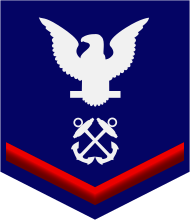
Petty Officer Third Class
Petty Officer
PO3
US Coast Guard Petty Officer Third Class (E-4) insigniaEagle perched on single chevron with rating specialty mark — the first "crow"
$2,661
$3,214
6+ yrs
Typically ~2–3 yrs from E-1 (Servicewide Exam + quota)
E-5
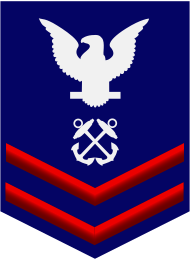
Petty Officer Second Class
Petty Officer
PO2
US Coast Guard Petty Officer Second Class (E-5) insigniaEagle + two chevrons + rating mark
$2,903
$3,846
12+ yrs
Typically ~4–5 yrs from E-1
E-6
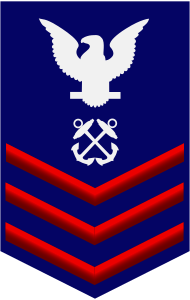
Petty Officer First Class
Petty Officer
PO1
US Coast Guard Petty Officer First Class (E-6) insigniaEagle + three chevrons + rating mark
$3,167
$4,720
20+ yrs
Typically ~7–10 yrs from E-1
E-7
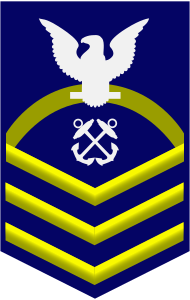
Chief Petty Officer
Chief Mess
CPO / Chief
US Coast Guard Chief Petty Officer (E-7) insigniaFouled anchor with "USCG" — khaki uniform unlocked
$3,661
$5,711
24+ yrs
Typically ~11–15 yrs from E-1 (Servicewide Exam + selection board)
E-8
Senior Chief Petty Officer
Chief Mess
SCPO / Senior
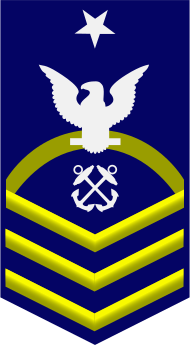
US Coast Guard Senior Chief Petty Officer (E-8) insigniaFouled anchor topped with one silver star
$5,245
$6,507
26+ yrs
Typically ~16–20 yrs from E-1
E-9
Master Chief Petty Officer
Chief Mess
MCPO / Master
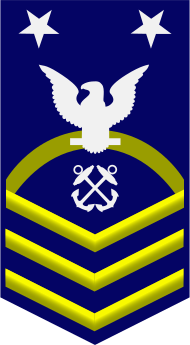
US Coast Guard Master Chief Petty Officer (E-9) insigniaFouled anchor topped with two silver stars
$6,620
$8,169
26+ yrs
Typically ~20+ yrs from E-1
W-2
Chief Warrant Officer 2
Warrant Officer
CWO2
US Coast Guard Chief Warrant Officer 2 (W-2) insigniaGold bar with three blue breaks
$4,301
$6,726
20+ yrs
Entry into CG WO program — typically from senior enlisted (E-6 and above)
W-3
Chief Warrant Officer 3
Warrant Officer
CWO3
US Coast Guard Chief Warrant Officer 3 (W-3) insigniaGold bar with two blue breaks
$4,868
$7,757
24+ yrs
Typically ~4–6 yrs after CWO2
W-4
Chief Warrant Officer 4
Warrant Officer
CWO4
US Coast Guard Chief Warrant Officer 4 (W-4) insigniaGold bar with one blue break
$5,325
$8,891
26+ yrs
Senior warrant grade in the Coast Guard (no W-5 in the CG)
O-1
Ensign
Junior Officer
ENS
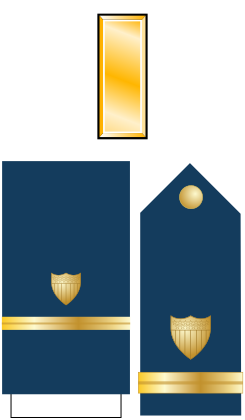
US Coast Guard Ensign (O-1) insigniaSingle gold bar (collar/shoulder); 0.5" stripe on sleeve
$3,826
$4,960
6+ yrs
Entry via USCGA, OCS, CSPI, or direct commissioning
O-2
Lieutenant Junior Grade
Junior Officer
LTJG
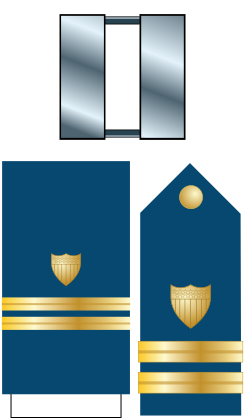
US Coast Guard Lieutenant Junior Grade (O-2) insigniaSilver bar; 0.5" + 0.25" sleeve stripe
$4,407
$6,095
4+ yrs
Typically ~18 months from O-1 (absent adverse record)
O-3
Lieutenant
Junior Officer
LT
US Coast Guard Lieutenant (O-3) insigniaTwo silver bars; two 0.5" sleeve stripes
$5,097
$8,393
14+ yrs
Typically ~4 yrs from commissioning
O-4
Lieutenant Commander
Senior Officer
LCDR
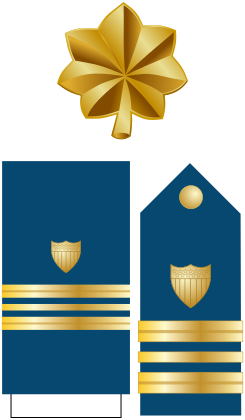
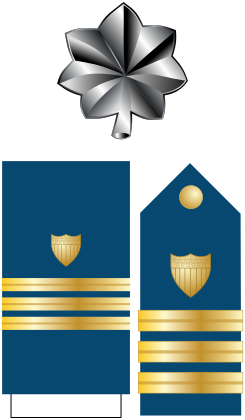
US Coast Guard Lieutenant Commander (O-4) insigniaGold oak leaf; 0.5"+0.25"+0.5" sleeve stripes
$5,800
$9,497
20+ yrs
Typically ~10–11 yrs from commissioning (first competitive board)
O-5
Commander
Senior Officer
CDR
US Coast Guard Commander (O-5) insigniaSilver oak leaf; three 0.5" sleeve stripes
$6,731
$11,174
22+ yrs
Typically ~15–17 yrs from commissioning
O-6
Captain
Senior Officer
CAPT
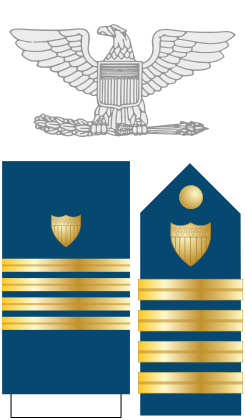
US Coast Guard Captain (O-6) insigniaSilver eagle; four 0.5" sleeve stripes
$8,072
$14,076
30+ yrs
Typically ~21–23 yrs from commissioning
O-7
Rear Admiral (Lower Half)
Flag Officer
RDML
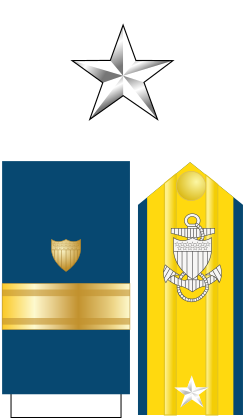
US Coast Guard Rear Admiral (Lower Half) (O-7) insigniaOne silver star; one 2" sleeve stripe
$10,633
$14,159
20+ yrs
Flag selection — small board, by-name
O-8
Rear Admiral
Flag Officer
RADM
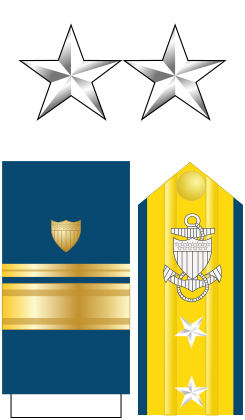
US Coast Guard Rear Admiral (O-8) insigniaTwo silver stars; one 2" + one 0.5" sleeve stripe
$12,836
$15,648
20+ yrs
Typically ~2–4 yrs after RDML
O-9
Vice Admiral
Flag Officer
VADM
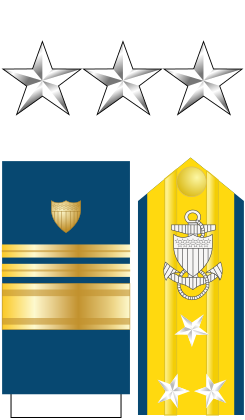
US Coast Guard Vice Admiral (O-9) insigniaThree silver stars; one 2" + two 0.5" sleeve stripes
$16,667
$16,667
20+ yrs (capped)
Three-star — Vice Commandant, Area Commanders, Deputy Commandants
O-10
Admiral
Flag Officer
ADM
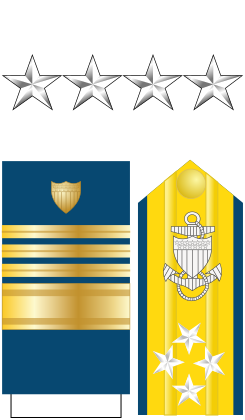
US Coast Guard Admiral (O-10) insigniaFour silver stars; one 2" + three 0.5" sleeve stripes
$17,675
$17,675
20+ yrs (capped)
Four-star — the Commandant of the Coast Guard

Source: 2026 DFAS projected basic pay tables (Title 37 USC §1009 increase applied uniformly across all services — pay is joint). Insignia descriptions reflect current Coast Guard Uniform Regulations (COMDTINST M1020.6 series).

Section 02 — Enlisted (E-1 through E-9)

Crows, anchors, and the long climb to the Mess

The Coast Guard’s enlisted force is small — approximately 30,000 active enlisted Coasties at any given time. The pipeline funnels everyone through Training Center Cape May, NJ, and then out to A-schools (most at Yorktown or Petaluma) and to first units. The smaller service means that the Chief Mess is small and that the cohort who pin anchors in any given year is measured in hundreds, not thousands.

US Coast Guard Seaman Recruit (E-1) insignia
E-1

Seaman Recruit

SR
On Paper

Most junior enlisted paygrade. New accession in basic recruit training. Expected to learn Coast Guard customs, basic seamanship, and the core competencies of a Coastie.

Reality

You exist at Training Center Cape May, New Jersey — the only enlisted boot camp in the Coast Guard. Eight weeks of marching, classroom indoctrination, swim qualification, weapons familiarization, and the small-boat handling that the larger sea services do not put their recruits through. The smooth sleeve is the mark. You leave Cape May as an E-2 if you graduate cleanly — Coast Guard practice has long been to advance recruits to Seaman Apprentice upon completion.

Culture

Cape May is a former resort town on the southern tip of the New Jersey shore. The Coast Guard has trained recruits there continuously since 1948 — every enlisted Coastie alive has marched the same drill pad.

US Coast Guard Seaman Apprentice (E-2) insignia
E-2

Seaman Apprentice

SA
On Paper

Promoted upon graduation from recruit training in most cases. Beginning to specialize via apprenticeship designations (Seaman, Fireman, Airman) or proceeding directly to a rating "A" school.

Reality

You have two stripes and a paycheck. From Cape May you go to either your first unit as a non-rate (a "non-rate" is a Coastie who has not yet earned a rating) or directly to an "A" school for your chosen rating. Coast Guard non-rates are highly visible at stations and on cutters — you stand watch, you handle lines, you scrub the brightwork, you learn the deck plate. The Coast Guard runs a smaller pipeline than the Navy and your face is in fewer rooms.

US Coast Guard Seaman (and group equivalents) (E-3) insignia
E-3

Seaman (and group equivalents)

SN
On Paper

Three stripes. Junior enlisted on track to earn a rating ("strike for a rate"). SN denotes the deck/general community, FN the engineering community, AN the aviation community.

Reality

You stand boat crew. You learn to handle a 25-foot Response Boat — Small at a station, or you turn wrenches in an engine room on a 270-foot Famous-class cutter, or you marshal MH-65s on a hangar deck at an air station. The Coast Guard is multi-mission by design: in a single week your unit may run search-and-rescue, board a fishing vessel for safety inspection, transit a buoy for aids-to-navigation maintenance, and post a security patrol on a port facility. As an E-3 you see all of it.

Culture

Coasties refer to themselves as "Coasties" without irony. The nickname has been adopted by the service — it is informal but used in official social media and recruiting materials, not just on the deck plate.

US Coast Guard Petty Officer Third Class (E-4) insignia
E-4

Petty Officer Third Class

PO3
On Paper

First petty officer rank. Earned by completing "A" school for a rating and passing the Servicewide Exam (SWE) with a sufficient cutoff score. Begins wearing "the crow" — the eagle perched on the chevron with the rating specialty mark.

Reality

You earned your crow and you are now a rated Coastie — Boatswain's Mate Third Class (BM3), Machinery Technician Third Class (MK3), Operations Specialist Third Class (OS3), Aviation Maintenance Technician Third Class (AMT3), or one of the other ratings. You run a watch station. On a 87-foot Marine Protector or a 110-foot Island-class patrol boat, a PO3 may be the senior person in their shop. The Coast Guard pushes responsibility deeper than the Navy because there are simply fewer bodies.

Career tip

The Servicewide Exam is rating-specific. The Coast Guard publishes a "rate training manual" and a bibliography for each exam cycle. Coasties who actually read the bibliography promote — the cutoff is competitive in oversubscribed ratings.

US Coast Guard Petty Officer Second Class (E-5) insignia
E-5

Petty Officer Second Class

PO2
On Paper

Mid-grade petty officer. Work-center supervisor for small shops. Senior watchstander. Often the Officer-in-Charge equivalent at a very small unit (Aids to Navigation Team, small boat station outpost).

Reality

A PO2 at a small boat station in Alaska may be the senior person on duty for an entire 12-hour watch — coxswain of the response boat, communications watch, deck supervisor, all at once. On a Famous-class or Bertholf-class cutter, the BM2 in deck department or the OS2 in the Combat Information Center is running a piece of the operational picture without an officer in the room. The Coast Guard does not have the layers of supervision the larger services do.

Culture

A PO2 in a Sector tactical command center is doing job-equivalent work to a PO1 or even a Chief on a Navy ship of comparable mission area. Smaller service, deeper trust at lower paygrades — for better and for worse.

US Coast Guard Petty Officer First Class (E-6) insignia
E-6

Petty Officer First Class

PO1
On Paper

Senior petty officer. Common as a Leading Petty Officer (LPO) for a division. Frequently the Officer-in-Charge (OIC) of a small boat station, an Aids to Navigation Team (ANT), or a buoy tender deck force. Eligible to test for E-7 (Chief).

Reality

PO1 is the rank where Coast Guard responsibility goes vertical. A BM1 or an MK1 can be the OIC of a small boat station — meaning they are the senior person at that unit, accountable directly to a Sector Commander, signing for the boats and the people. In the Navy a comparable billet would go to a Chief or a JG. The Coast Guard has long given OIC authority to E-6 and E-7 Coasties.

Career tip

OIC of a station is a career-defining tour. A clean OIC tour with a strong Officer Evaluation Report (OER-equivalent enlisted eval) is the single strongest predictor of selection to Chief in the deck and engineering ratings.

US Coast Guard Chief Petty Officer (E-7) insignia
E-7

Chief Petty Officer

CPO
On Paper

Senior enlisted leader. Advises the wardroom (officers). Mentors junior enlisted. Selected by a board of senior chiefs and master chiefs — not just by exam.

Reality

The Chief Mess in the Coast Guard mirrors the Navy Chief Mess in form and weight. Selection to E-7 is a board, not an exam alone. The pinning ceremony is preceded by a Chiefs Call to Indoctrination (CCTI) — the service's formal mentorship and induction period for selectees. Chiefs in khaki run the deck plate of every Coast Guard unit. On smaller cutters and at stations, the senior Chief is often the Officer-in-Charge, accountable for the unit the way a CO is on a larger ship.

Culture

Coast Guard chiefs eat in the Chief Mess (when there is one — many small units do not have separate messing), wear the same fouled anchor as Navy chiefs, and protect the same traditions. The pinning is a public, family-attended event and the moment your career changes character.

US Coast Guard Senior Chief Petty Officer (E-8) insignia
E-8

Senior Chief Petty Officer

SCPO
On Paper

Senior advisor at the department or unit level. Often a Command Senior Chief at a smaller command. Promotion is competitive by selection board.

Reality

Senior Chiefs in the Coast Guard often fill billets that in the Navy would go to a Master Chief — there simply are not as many bodies in the Coast Guard Chief Mess. A Senior Chief at a Sector is the technical and personnel authority for the department, and on smaller cutters a SCPO can be the senior enlisted advisor to the CO directly.

US Coast Guard Master Chief Petty Officer (E-9) insignia
E-9

Master Chief Petty Officer

MCPO
On Paper

Senior enlisted advisor at the command level. Master in the rating. Often Command Master Chief (CMC) at a Sector, Area, or major command.

Reality

A Master Chief in the Coast Guard is a rare bird — the service is small and the E-9 population is small with it. A good Master Chief at a Sector or Area shapes the entire enlisted experience for that region. There are command-rating Master Chiefs (e.g., the senior BM Master Chief, the senior AMT Master Chief) who serve as the rating's representative in service-wide policy.

Culture

When you reach Master Chief in a service this small, your name is known across the fleet. The community of CG E-9s is measured in hundreds, not thousands.

US Coast Guard Command Master Chief (E-9 (special billet)) insignia
E-9 (special billet)

Command Master Chief

CMC
On Paper

Command-level senior enlisted leader. Member of the "Triad" with the Commanding Officer and Executive Officer. Provides unfiltered enlisted perspective directly to the CO.

Reality

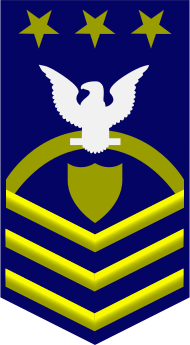
The CMC at a Sector or Area is the only enlisted Coastie in the command with direct, no-knock access to the senior officer. A strong CMC reshapes how an entire region operates — what the men and women on the small boats experience day to day is partly downstream of what the CMC and the Sector Commander decide together.

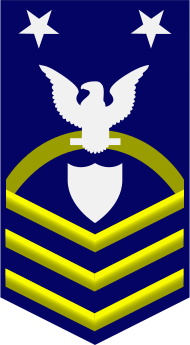
US Coast Guard Master Chief Petty Officer of the Coast Guard (E-9 (single billet)) insignia
E-9 (single billet)

Master Chief Petty Officer of the Coast Guard

MCPOCG
On Paper

Single-incumbent senior enlisted leader of the U.S. Coast Guard. Advises the Commandant of the Coast Guard on all enlisted matters. Selected by the Commandant.

Reality

One Coastie in the entire service. Wears unique sleeve and collar insignia distinguishing the position from any other Master Chief. Travels constantly across the service, testifies before Congress, and signs his or her name to the cultural direction of the enlisted force. The MCPOCG is the enlisted counterpart to the Commandant.

Section 03 — Warrant Officers (CWO2 through CWO4)

The technical commissioned track the Coast Guard runs heavily on

The Coast Guard accessions warrant officers from senior enlisted Coasties (typically E-6 and above). The CG warrant ladder is shorter than the other services’ — there is no W-1 entry grade, and no W-5 senior grade. CWO2 is entry; CWO4 is the senior warrant rank. Coast Guard CWOs hold technical billets across every specialty — deck, engineering, aviation, marine safety, intelligence, information systems — and are deeply embedded in the operational fabric of the service.

US Coast Guard Chief Warrant Officer 2 (W-2) insignia
W-2

Chief Warrant Officer 2

CWO2
On Paper

Technical specialist commissioned officer. Entry warrant grade in the Coast Guard. Accessioned from senior enlisted Coasties (typically E-6 and above) who apply, are boarded, and are selected.

Reality

You were a Chief or a senior PO1 who applied for the CWO program, screened, and put up your single gold bar with the blue breaks. You are now in the wardroom but you are still the technical master in your specialty (deck, engineering, aviation, marine safety, intelligence, information systems). Coast Guard CWOs are deeply respected because the service depends on them to run the technical departments that the line officer corps does not have the time-in-rate or the training pipeline to fully cover.

Culture

The Coast Guard does not have a W-1 grade — accession is directly to CWO2. The CG also does not have a W-5 grade — CWO4 is the senior warrant rank. The CG warrant officer community is tight-knit and small.

US Coast Guard Chief Warrant Officer 3 (W-3) insignia
W-3

Chief Warrant Officer 3

CWO3
On Paper

Senior technical specialist. Competitive promotion from CWO2 by selection board.

Reality

A CWO3 may be running a department on a major cutter, serving as the Engineer Officer on a medium-endurance cutter, or holding a marine safety or intelligence billet at a Sector. The CWO3 has earned the trust to act with department-head-level authority in their specialty.

US Coast Guard Chief Warrant Officer 4 (W-4) insignia
W-4

Chief Warrant Officer 4

CWO4
On Paper

Senior-most warrant grade in the Coast Guard. Master technical specialist. May hold department-head billets at major commands.

Reality

There is no CWO5 in the Coast Guard, which makes CWO4 the senior warrant rank in the service. CWO4s typically serve at Area, District, or major Sector commands as the senior technical voice in their specialty. Pay at CWO4 with 26+ YOS rivals an O-4 with similar service.

Section 04 — Commissioned Officers (ENS through ADM)

From gold bar to four stars (in a service that has only one four-star)

The Coast Guard commissions roughly a few hundred new officers each year through the U.S. Coast Guard Academy, Officer Candidate School at the Leadership Development Center in New London, the College Student Pre-Commissioning Initiative (CSPI), and direct accession for specialty fields (aviation, JAG, medical). The officer corps is small — flag selection is highly competitive across a single small cohort of O-6s each year, and the Commandant is the only standing four-star billet in the service.

US Coast Guard Ensign (O-1) insignia
O-1

Ensign

ENS
On Paper

First commissioned officer paygrade. Junior officer afloat or at a Sector. Most ENS come from the U.S. Coast Guard Academy in New London, Connecticut; Officer Candidate School in Yorktown, Virginia; or the College Student Pre-Commissioning Initiative (CSPI).

Reality

You wear one gold bar and you are learning. Your first afloat tour as an ENS is typically Deck Watch Officer (DWO) under instruction aboard a medium- or high-endurance cutter, where you stand bridge watches, qualify on the Combat Information Center, and learn to handle a 270- or 418-foot ship in formation and in port. At a Sector or air station, an ENS is a junior staff officer learning the operational rhythm. Smart ENS shut up and learn from the Chiefs and CWOs.

Culture

The Coast Guard Academy graduates a comparatively small class each year — far smaller than USNA, USMA, or USAFA. The class size shapes the culture: every Academy graduate knows a meaningful percentage of their officer corps personally.

US Coast Guard Lieutenant Junior Grade (O-2) insignia
O-2

Lieutenant Junior Grade

LTJG
On Paper

Junior commissioned officer. Continuing as a Deck Watch Officer or moving into the qualification track for the next watchstanding level. Aviation O-2s are flight students or new pilots in fleet replacement squadrons.

Reality

LTJG is essentially the back half of your first afloat tour or your first ashore tour. Promotion from O-1 to O-2 is automatic at 18 months absent an adverse record. You are working through your warfare qualifications — Cutterman pin for afloat officers, pilot wings for aviation officers, marine safety qualifications for prevention officers, and the Officer-in-Charge of Marine Inspection (OCMI) pipeline for the prevention community.

Career tip

The Coast Guard Cutterman insignia (often called "the Cutterman pin") requires 5 years of cumulative sea duty for permanent award. Earning the temporary device at 3 years and the permanent device at 5 is a meaningful career milestone for any afloat officer.

US Coast Guard Lieutenant (O-3) insignia
O-3

Lieutenant

LT
On Paper

Junior commissioned officer at the senior end of "junior." May serve as Department Head aboard a medium-endurance cutter, Operations Officer at a Sector, or pilot-in-command on an MH-65, MH-60, HC-130, or HC-144.

Reality

Department Head tour is where afloat careers are made. As DH on a 270-foot Famous-class or 418-foot National Security Cutter, you sign off on every casualty, every drill, every inspection in your department. In aviation, this is your aircraft commander upgrade and your tactical lead progression. In prevention, this is your OCMI investigations and your port-state-control inspections of arriving foreign-flag vessels.

Culture

The Coast Guard officer career is broader than the Navy's in operational variety — a single LT can spend a tour underway interdicting cocaine north of Colombia, a tour ashore as a port state control officer in a major container port, and a tour at HQ writing policy. Few services move officers across mission areas as routinely.

US Coast Guard Lieutenant Commander (O-4) insignia
O-4

Lieutenant Commander

LCDR
On Paper

Senior officer. First "field grade" equivalent. Eligible for executive officer (XO) billets aboard medium-endurance cutters, department head billets aboard high-endurance cutters, or operations officer at major Sectors.

Reality

Promotion from O-3 to O-4 is the first real cut in the Coast Guard officer corps. The selection board looks at your Officer Evaluation Reports (OERs), your operational tours, and whether you took the hard jobs (XO afloat, OIC at a small unit, deployed staff billets). If you make O-4 you are very likely to retire at 20 — the service invests in keeping LCDRs.

US Coast Guard Commander (O-5) insignia
O-5

Commander

CDR
On Paper

Senior officer. First major-cutter command opportunity (Commanding Officer of a Famous-class WMEC, an Alex Haley, or a comparable platform). Also Deputy Sector Commander at major Sectors, Operations Officer at District, or Commanding Officer of an Air Station.

Reality

CDR is the first paygrade with major command opportunity in the cutter fleet. The CDR-Command screen is one of the most consequential boards in a Coast Guard officer's career. Screening for command of a 270-foot medium-endurance cutter or a major Air Station puts you on the career path that can lead to O-6 major command and, in rare cases, flag rank.

Culture

"Captain" is what a crew calls the commanding officer of any Coast Guard cutter, regardless of the CO's actual paygrade. A CDR commanding a 270 is "Captain" on his or her ship and "Commander" everywhere else.

US Coast Guard Captain (O-6) insignia
O-6

Captain

CAPT
On Paper

Senior officer. "Major command" opportunity — Commanding Officer of a National Security Cutter (Bertholf-class, 418 feet), Sector Commander at a major Sector, District Chief of Staff, or major HQ directorate billet.

Reality

The four-stripe is the senior leadership of the Coast Guard at the deck-plate level. Captains command Sectors that cover thousands of miles of coastline; they command the largest cutters in the fleet; they run major HQ branches. The eagles on the collar carry institutional weight that no LT or LCDR can match.

Culture

Sector Commanders (typically O-6s) sit at the intersection of operations, prevention, response, and law enforcement for an entire region. A Sector Commander's area of responsibility may span hundreds of miles of coastline, dozens of ports, and several thousand commercial vessels.

US Coast Guard Rear Admiral (Lower Half) (O-7) insignia
O-7

Rear Admiral (Lower Half)

RDML
On Paper

First flag rank. One star. Typically commands a District (e.g., 1st, 5th, 7th, 8th, 9th, 11th, 13th, 14th, 17th) or holds a major HQ directorate billet.

Reality

Selection to flag rank in the Coast Guard is competitive across all O-6s and the cohort is small — there are far fewer Coast Guard flag officers than in the larger services. District Commanders (RDMLs) are the operational commanders for a region — they sit one level below the Area Commanders and one above the Sector Commanders.

US Coast Guard Rear Admiral (O-8) insignia
O-8

Rear Admiral

RADM
On Paper

Two-star flag. Typically a Deputy Assistant Commandant, a Deputy Area Commander, or a senior HQ billet.

Reality

Two-star flag billets in the Coast Guard are typically deputy-level or major directorate roles at HQ. The path from RDML to RADM is competitive — most RDMLs do not advance further.

US Coast Guard Vice Admiral (O-9) insignia
O-9

Vice Admiral

VADM
On Paper

Three-star flag. The Vice Commandant, the Area Commanders (Atlantic Area and Pacific Area), and the Deputy Commandant for Operations are typically O-9 billets.

Reality

There are typically a small number of Coast Guard three-stars on active duty at any time. The Area Commanders (LANTAREA in Portsmouth, VA and PACAREA in Alameda, CA) are the senior operational commanders in their hemispheres and report directly to the Commandant.

US Coast Guard Admiral (O-10) insignia
O-10

Admiral

ADM
On Paper

Four-star. The Commandant of the Coast Guard is the only four-star billet in the service.

Reality

The Commandant of the Coast Guard is the senior uniformed officer of the service and a member of the Joint Chiefs of Staff. The Commandant is nominated by the President, confirmed by the Senate, and serves a fixed four-year term. The Vice Commandant has at times also been a four-star, but the Commandant is the canonical O-10 billet.

Section 05 — Culture

The other rank structure: who actually runs the unit

The formal paygrade chart is one institution. The Chief Mess is another. The mission communities (deck, engineering, aviation, marine safety, intelligence, response, prevention) are a third. The Triad is a fourth. None of them appear on a recruiting brochure but all four shape every day of life in the U.S. Coast Guard.

Force Structure

The smallest armed service: why everyone wears more hats

The Coast Guard is the smallest of the United States armed services by active-duty headcount. Active-duty strength is in the low tens of thousands — for context, that is smaller than the New York City Police Department. The smaller force shapes everything about Coast Guard culture: a single PO1 is often the senior person at an entire unit; a single Sector Commander is responsible for thousands of miles of coastline; and individual Coasties routinely operate with authorities and responsibility that, in the larger services, would be reserved for paygrades two or three steps higher.

  • Coast Guard units include cutters (commissioned ships 65 feet and longer), patrol boats, small boat stations, Aids to Navigation Teams, air stations, Sector commands, and District/Area headquarters.
  • Most stations and small cutters are run by a senior enlisted Officer-in-Charge (E-6 or E-7), not by a commissioned officer.
  • The Coast Guard Reserve adds meaningful capacity for surge missions — hurricane response, port security, marine environmental response.
  • The Coast Guard Auxiliary is a separate civilian volunteer organization that augments many Coast Guard missions; Auxiliarists are not service members but they wear distinctive uniforms and contribute thousands of hours annually.
Operations

Multi-mission: SAR, drug interdiction, AtoN, marine safety, ports & waterways

The Coast Guard operates across a wide set of statutory missions simultaneously. A single cutter underway in the Caribbean may run counter-narcotics patrols, conduct migrant interdiction, respond to a vessel in distress for search-and-rescue, and assist a foreign coast guard partner — all in the same patrol. A small boat station may run a SAR case at noon, board a fishing vessel for a fisheries inspection at 1500, and conduct a port-security patrol that evening. Coast Guard ratings and officers are expected to be fluent in multiple mission areas, not specialists in one.

  • Search and Rescue (SAR) — the historical core mission. The Coast Guard responds to tens of thousands of SAR cases per year across U.S. waters.
  • Drug Interdiction — high-endurance and medium-endurance cutters deploy to the Eastern Pacific and Caribbean to interdict maritime cocaine shipments, often working with allied navies and law enforcement.
  • Aids to Navigation (AtoN) — buoy tenders and Aids to Navigation Teams maintain the navigation buoys, beacons, and lights that mark U.S. waterways.
  • Marine Safety — Coast Guard marine inspectors examine U.S.-flag commercial vessels and foreign-flag vessels in U.S. ports, enforce federal pollution and shipping safety law, and investigate marine casualties.
  • Ports, Waterways, and Coastal Security (PWCS) — port security units, maritime safety and security teams, and Sector patrols protect critical port infrastructure.
  • Defense Readiness — the Coast Guard is a military service and trains for wartime missions; Patrol Forces Southwest Asia (PATFORSWA) maintains a continuous Coast Guard presence in the Persian Gulf region under Navy operational control.
The Deck

Boatswain's Mate (BM): the historical heart of the deck force

The Boatswain's Mate is the Coast Guard's deck rating — the descendants of the surfmen who ran the U.S. Life-Saving Service stations on the East and West Coasts in the nineteenth century. BMs run the deck departments on cutters, coxswain the response boats at small boat stations, and frequently serve as Officers-in-Charge of small units. The BM rating carries a heritage that predates the Coast Guard's 1915 formation (when the Life-Saving Service merged with the Revenue Cutter Service to form the modern Coast Guard).

  • Boatswain's Mates are eligible for OIC of nearly every type of small boat station and many smaller cutters — a path that in the Navy is typically reserved for officers.
  • The BM rating is one of the largest in the Coast Guard by population.
  • Boatswain's Mate "A" school is at Training Center Yorktown, Virginia.
  • Surfman is a Coast Guard specialty within the BM community for coxswains qualified to operate motor lifeboats in heavy weather; the Surfman insignia is a distinct device and the qualification is famously hard to earn.
The Mess

The Chief Mess in the Coast Guard

The Coast Guard Chief Mess shares its form and most of its traditions with the Navy Chief Mess: khaki uniforms, the fouled anchor, the combination cover, and the institution of the Chief's pinning. Selection to E-7 is by a board of senior chiefs and master chiefs, and selectees go through the Chiefs Call to Indoctrination (CCTI) — a service-wide induction and mentorship period that culminates in the public pinning ceremony.

  • Coast Guard chiefs wear khakis with the fouled anchor and "USCG" device — visually nearly identical to Navy chiefs except for the service designator.
  • Selection to Chief is competitive — a Servicewide Exam alone does not promote you; the selection board considers your entire record.
  • The Chiefs Call to Indoctrination period is the modern Coast Guard equivalent of "CPO Season" — formal mentorship leading up to pinning.
  • At smaller Coast Guard units there may be only one Chief on board; the Mess is service-wide rather than ship-by-ship.
Duty Environments

Sector vs. cutter vs. small boat station: three different Coast Guards

A Coast Guard career is shaped by which of three primary duty environments you rotate through: afloat on a cutter, ashore at a small boat station, or staff at a Sector or District. Each has its own rhythm, its own watch schedule, and its own culture. Aviation adds a fourth track — air stations — with its own community.

  • Cutters — commissioned Coast Guard ships, 65 feet and longer. Classes include the 87-foot Marine Protector, the 154-foot Sentinel-class Fast Response Cutter, the 210/270-foot medium-endurance cutters, and the 418-foot Bertholf-class National Security Cutter. Polar icebreakers (Polar Star and Healy) operate from Seattle.
  • Small boat stations — the historical Life-Saving Service legacy. Stations operate Response Boats and other small craft, typically run by an enlisted Officer-in-Charge (E-6 or E-7), responsible for SAR and law enforcement in a coastal area.
  • Sectors — operational regional commands. Each Sector is run by an O-6 Sector Commander and integrates response operations, prevention (marine safety and inspections), and intelligence/law-enforcement coordination for a region.
  • Air stations — fixed-wing (HC-130 Hercules, HC-144 Ocean Sentry, HC-27J Spartan) and rotary-wing (MH-60 Jayhawk, MH-65 Dolphin) operations. Aviation Coasties rotate through air stations from Cape Cod to Kodiak.
Officer Pipelines

USCGA, OCS, CSPI, and direct commissioning

The Coast Guard accessions officers through several formal pipelines. The Coast Guard Academy in New London, Connecticut, is the service's only senior military academy and graduates a small class each year. Officer Candidate School is conducted at the Leadership Development Center at the Academy in New London. The College Student Pre-Commissioning Initiative (CSPI) is a four-year scholarship program for college students at minority-serving institutions and other partner colleges. Direct commissioning paths exist for lawyers, medical officers, aviators, and other specialties.

  • USCGA — the U.S. Coast Guard Academy is a four-year federal service academy in New London, CT. Admission is direct (no congressional nomination required, unlike USMA/USNA/USAFA).
  • OCS — 17 weeks at the Leadership Development Center, co-located with the Academy in New London. Open to college graduates and to certain enlisted Coasties.
  • CSPI — a scholarship and commissioning program for college sophomores and juniors that pays tuition and provides a stipend in exchange for a service obligation.
  • Direct Commission — for attorneys (JAG), aviators, medical officers, and other specialty accessions.
  • Coast Guard Auxiliary University Programs (AUP) and other small pipelines fill in additional accession needs.
Wings of Gold

Coast Guard aviation: small, deep, and almost entirely SAR-and-prosecution

The Coast Guard aviation enterprise is small relative to the Navy or the Air Force but it is one of the most experienced rescue communities in the world. Pilots fly the MH-65 Dolphin (short-range recovery) and MH-60T Jayhawk (medium-range recovery) helicopters, and the HC-130, HC-144, and HC-27J fixed-wing aircraft for long-range search, surveillance, and logistics. Coast Guard rescue swimmers — the AST rating (Aviation Survival Technician) — are the operational descendants of the rescue swimmer program and conduct most U.S. coastal and offshore swimmer rescues.

  • Coast Guard pilots are commissioned officers; flight training takes place primarily through Navy flight schools in Pensacola and follow-on Coast Guard training at Aviation Training Center Mobile.
  • Aviation Survival Technicians (ASTs) — the rescue swimmer rating — are enlisted Coasties. The "A" school is at AvTechTrac Elizabeth City and the attrition rate is real.
  • Aviation Maintenance Technicians (AMTs), Avionics Electrical Technicians (AETs), and other aviation ratings keep the aircraft flying.
  • Coast Guard air stations are spread across the United States and territories — from Air Station Cape Cod to Air Station Kodiak in Alaska.
Chain of Command

Why the Coast Guard reports to DHS, not DoD

The Coast Guard is one of the six branches of the U.S. armed forces under federal law (Title 14 of the U.S. Code), but in peacetime it operates under the Department of Homeland Security rather than the Department of Defense. The Coast Guard transfers to the Department of the Navy in time of war or when the President directs — the last sustained transfer of that kind was during World War II. The DHS chain of command has practical consequences for funding, procurement, and the political environment surrounding the service.

  • Authorization: 14 USC §103 names the Coast Guard as a military service at all times.
  • Peacetime chain: Commandant → Secretary of Homeland Security → President.
  • Wartime chain: by Presidential direction, Coast Guard forces transfer to the Department of the Navy and operate under Navy operational control.
  • PATFORSWA (Patrol Forces Southwest Asia) operates under Navy operational control in the Persian Gulf region while the Coasties assigned to it remain Coast Guard service members.
  • Coast Guard members are entitled to the same federal military benefits as the other services — TRICARE, GI Bill, VA, Title 10 protections — though the Coast Guard's funding flows through DHS rather than DoD.
Command Structure

The Triad: CO, XO, and CMC — scaled to a smaller service

Every Coast Guard unit large enough to have a wardroom has a "Triad" at the top: the Commanding Officer, the Executive Officer, and the Command Master Chief (or comparable senior enlisted leader). On a high-endurance or National Security Cutter, the Triad operates the way it does on a Navy ship of equivalent size. On smaller units, the Triad may be just a CO and an OIC of the enlisted leadership — but the principle is the same.

  • CO — Final authority on board. Signs every report. Responsible for everything that happens at the unit. Typically O-5 (Sentinel-class FRCs, medium-endurance cutters, small Air Stations) or O-6 (National Security Cutters, major Air Stations, Sectors).
  • XO — Second in command. Runs the day-to-day. On smaller cutters the XO may also stand bridge watches and act as a department head.
  • CMC — At Sectors, Areas, Districts, and the largest cutters, a Command Master Chief is part of the Triad. At smaller units, the senior Chief on board fills the equivalent advisory role.
Reserve Component

The Coast Guard Reserve: hurricane surge, port security, and federal emergency response

The Coast Guard Reserve falls under DHS like the active component and is integrated into the Coast Guard's operational structure. Reservists drill one weekend a month and conduct annual training, and they are routinely activated for major events — hurricane response, port-security surges, federal emergency declarations, and major maritime incidents. Reserve Coasties wear the same uniform and the same rank insignia as active-duty Coasties and are governed by the same service traditions.

  • Reserve members are eligible for the same federal benefits as the active force when activated under Title 10 (federal active duty).
  • Common Reserve mission areas include port security units (PSUs), marine safety detachments, and IT/intelligence augmentation at Sectors.
  • The Coast Guard Reserve is comparatively small (thousands, not tens of thousands) — the surge capacity is significant for the service's size.
Section 06 — Promotion Timeline

How long from Cape May to Khaki (and from bar to eagle)

Time-in-grade (TIG) requirements are published in the Coast Guard Personnel Manual (COMDTINST M1000.2 series) and the Enlisted Accessions, Evaluations, and Advancements COMDTINST. Numbers below are typical, not promises — actual advancement depends on rating quotas, Servicewide Exam scores, evaluations, and (at E-7 and above) the selection board. Some Coasties advance faster, others slower; the broad shape is reliable.

Enlisted timeline (E-1 to E-9)

E-1 → E-2
On boot graduation
Most recruits advance to SA upon graduating Cape May
E-2 → E-3
~6 months TIG
Typically automatic with satisfactory performance and "A" school progress
E-3 → E-4
~6 months TIG + SWE
Servicewide Exam plus rating quota — first selective promotion
E-4 → E-5
~12 months TIG + SWE
Servicewide Exam plus quota; meaningful rating-by-rating variance
E-5 → E-6
~36 months TIG + SWE
Competitive; OIC tours and operational performance weigh heavily
E-6 → E-7 (Chief)
SWE + selection board
Two-step: pass exam, then selection board. Typically ~11-15 yrs total
E-7 → E-8 (Senior)
Selection board only
No exam at E-8+. Competitive across a small cohort
E-8 → E-9 (Master)
Selection board only
By selection board only; cohort is small

Officer timeline (ENS to CAPT and beyond)

ENS (O-1) → LTJG (O-2)
~18 months
Essentially automatic absent adverse record
LTJG (O-2) → LT (O-3)
~24 months
Automatic in most cases
LT (O-3) → LCDR (O-4)
~10-11 yrs from commissioning
First real promotion board
LCDR (O-4) → CDR (O-5)
~15-17 yrs from commissioning
CDR-Command screen shapes career trajectory
CDR (O-5) → CAPT (O-6)
~21-23 yrs from commissioning
Major command screen; further narrowing
CAPT (O-6) → RDML (O-7)
By flag selection
Highly competitive; cohort is small in a small service
Section 07 — Pay Reality

Base pay is only the start (BAH, BAS, Sea Pay, Flight Pay, HDIP)

DFAS base pay is the floor. Total monthly compensation for any Coastie is base + BAH + BAS + community-specific special pays. Coast Guard pays are joint across the U.S. armed services — the same line items the Navy, Army, Marines, and Air Force use are available to Coasties in qualifying duty. The Coast Guard does not have submarine pay (the service does not operate submarines) and does not have Hostile Fire / Imminent Danger Pay in U.S. waters, but PATFORSWA Coasties in the Persian Gulf receive HFP/IDP and Combat Zone Tax Exclusion (CZTE) like other deployed service members.

BAH (Basic Allowance for Housing)

Location-based, dependent-status-based. Major Coast Guard BAH markets include Alameda, CA; Seattle, WA; Honolulu, HI; Portsmouth, VA; Cape Cod, MA; Kodiak, AK; and Miami, FL. Coasties stationed in high-cost cities (Alameda, Honolulu) receive significantly larger BAH than those at inland or smaller-market posts. Use the DoD BAH calculator at defensetravel.dod.mil for the current ZIP-code numbers.

BAS (Basic Allowance for Subsistence)

Standard 2026 enlisted BAS is approximately $470/month; officer BAS approximately $323/month. Tax-free. Paid to all Coasties except those required to mess on board (where BAS may be offset). Same rate across all services.

Career Sea Pay (CSP)

Paid to enlisted and officers serving on a designated sea-duty unit (most cutters 65 feet and longer). Rates increase with consecutive sea time and with paygrade. CSP can add a meaningful amount to monthly take-home for Coasties on long cutter tours. Same authorization as the Navy uses for its Sea Pay.

Aviation Career Incentive Pay (ACIP)

Flight pay for commissioned officer aviators (pilots). Tiered by total years of aviation service. Typically several hundred dollars per month depending on YOS bracket. Coast Guard pilots receive ACIP under the same statute as Navy, Army, and Air Force aviators.

Hazardous Duty Incentive Pay (HDIP)

Paid to enlisted aircrew (including ASTs, AETs, AMTs in flight status), to qualified divers, and to other Coasties in hazardous-duty assignments. Flight HDIP, parachute HDIP, and dive HDIP each have their own qualification and pay rates.

Coast Guard Special Pays and Bonuses

The Coast Guard pays Selective Reenlistment Bonuses (SRBs) for hard-to-fill ratings, a Critical Skills Retention Bonus for some specialties, and accession bonuses for select hard-to-fill ratings (AST, MK, and others have appeared on bonus lists in recent ALCOAST cycles). Check current ALCOAST announcements for the live bonus matrix.

Reality check

A Coastie’s LES (Leave and Earnings Statement) is the only authoritative record of what they actually take home. Special pays start and stop with duty status — rotate off a cutter, no Sea Pay; off flight status, no ACIP; off dive status, no Dive Pay. The drop when you return to shore duty after a long cutter tour can be a meaningful percentage of monthly take-home. Coast Guard housing also does not get the same volume of base-housing options as the larger services in many markets; BAH covers off-base rent in most areas but the search can be long in high-cost cities.

Section 08 — Insignia Guide

Decoding the sleeve, the collar, and the cover

The Coast Guard uses rank insignia closely modeled on the Navy’s. The Service Dress Blue uniform uses sleeve stripes for officers and Chiefs. The Operational Dress Uniform (ODU) — the working uniform that replaced the older utility uniform — uses collar devices for officers and warrant officers, and the chief or rating insignia on a chest tab for enlisted Coasties. The same Coastie wears different insignia placement depending on the uniform of the day.

Enlisted E-1 to E-3 (Seaman / Fireman / Airman)

Service Dress Blue: diagonal stripes on the left sleeve (1 stripe = E-2, 2 = E-2 transitional, 3 = E-3). Group rate color identifies the apprenticeship community (deck/engineering/aviation).

Enlisted E-4 to E-6 (Petty Officer)

Service Dress Blue: eagle ("crow") perched above chevrons (1, 2, or 3) on the left sleeve, with the rating specialty mark between the eagle and the chevrons. ODU: rate insignia on a chest tab.

Enlisted E-7 to E-9 (Chiefs)

Khakis / Tropical Blue Long / Service Dress Blue: fouled anchor with "USCG" device on the collar or as a sleeve rate (E-7), anchor with one silver star (E-8), anchor with two silver stars (E-9). The Master Chief Petty Officer of the Coast Guard (MCPOCG) wears a unique device distinguishing the position from any other E-9.

Warrant Officers (CWO2-CWO4)

Collar: gold bar with blue breaks. CWO2 = three breaks. CWO3 = two breaks. CWO4 = one break. (The Coast Guard does not use CWO5.)

Junior Officers (O-1 to O-3)

Collar: gold bar (ENS), silver bar (LTJG), two silver bars (LT). Service Dress Blue sleeve: 0.5" stripe (ENS); 0.5" + 0.25" stripe (LTJG); two 0.5" stripes (LT).

Senior Officers (O-4 to O-6)

Collar: gold oak leaf (LCDR), silver oak leaf (CDR), silver eagle (CAPT). Sleeve: LCDR = 0.5" + 0.25" + 0.5"; CDR = three 0.5" stripes; CAPT = four 0.5" stripes.

Flag Officers (O-7 to O-10)

Stars on the collar (1-4). Sleeve: 2" stripe ("flag stripe") plus 0.5" stripes for each rank above RDML. Flag officers wear a distinctive combination cover with embroidered devices on the bill.

Cutterman and Surfman insignia

Distinct from rank insignia. The Cutterman insignia (silver or gold) is worn by Coasties with cumulative sea-duty time. The Surfman insignia is a specialty device for BMs qualified to operate motor lifeboats in heavy weather. Both are visible markers of operational experience independent of rank.

FAQ

Common questions about Coast Guard ranks

Is the Coast Guard a military service?

Yes. The Coast Guard is one of the six branches of the United States armed forces under Title 14 of the U.S. Code. Coast Guard members are uniformed service members, hold federal military rank, are subject to the Uniform Code of Military Justice (UCMJ), and are entitled to the same federal military benefits (TRICARE, GI Bill, VA, military retirement) as members of the other services. The Coast Guard operates under the Department of Homeland Security in peacetime; under federal law it transfers to the Department of the Navy in time of war or when the President directs.

What is the highest rank in the U.S. Coast Guard?

The highest rank in the U.S. Coast Guard is Admiral (O-10, four stars). The Commandant of the Coast Guard is the only standing four-star billet in the service. The Commandant is a member of the Joint Chiefs of Staff. The Coast Guard does not have a five-star rank.

Why does the Coast Guard have orange and blue stripes on its ships and aircraft?

The orange-and-blue diagonal stripe ("the racing stripe") was added to Coast Guard ships, aircraft, and shore facilities beginning in the late 1960s as a visual identifier. The design was developed by the industrial design firm Raymond Loewy/William Snaith Inc. and adopted service-wide starting in 1967. The stripe makes Coast Guard assets identifiable at a distance and on camera, and is now one of the most recognizable visual markers of the service.

Does the Coast Guard deploy overseas?

Yes. The Coast Guard deploys overseas in several ways. Patrol Forces Southwest Asia (PATFORSWA) is a forward-deployed Coast Guard force based in Bahrain that operates under Navy operational control in the Persian Gulf region. Coast Guard cutters routinely deploy to the Eastern Pacific and Caribbean for counter-narcotics operations, work with allied coast guards and navies, and conduct international engagement patrols. The Coast Guard also operates polar icebreakers that conduct extended missions in the Arctic and Antarctic.

What does MCPOCG stand for?

MCPOCG stands for Master Chief Petty Officer of the Coast Guard. There is only one MCPOCG in the entire service at any time. The MCPOCG is the senior enlisted advisor to the Commandant of the Coast Guard and serves as the representative voice of the enlisted force. The MCPOCG wears unique sleeve and collar insignia that distinguish the position from any other E-9 in the service.

How is Coast Guard advancement different from Navy advancement?

The two systems are similar in shape but different in scale. Both services use a Servicewide Exam (SWE) plus a quota system for advancement to E-4 through E-6, and both use a selection board for E-7 (Chief), E-8 (Senior Chief), and E-9 (Master Chief). The Coast Guard's smaller enlisted force means fewer billets at each paygrade, which can make competition tighter in some ratings; on the other hand, the Coast Guard pushes responsibility deeper, so a PO1 in the Coast Guard may already be Officer-in-Charge of a station while a Navy E-6 of similar service might still be a watchstander on a larger ship.

What is the difference between Coast Guard and Navy ranks?

The Coast Guard and Navy share the same rank titles from E-1 through E-9 and from O-1 through O-10 — both services use Petty Officer/Chief Petty Officer for enlisted and Ensign through Admiral for officers. The two main structural differences: (1) the Coast Guard does not have a W-1 or W-5 grade (its warrant officer ladder is CWO2 → CWO3 → CWO4 only); (2) the Coast Guard does not have a five-star rank, and its highest standing rank is Admiral (O-10), the Commandant. Insignia are visually very similar to the Navy's, with the Coast Guard service designator (often "USCG" instead of "USN" on chief insignia and similar small differences).

Where is Coast Guard boot camp?

Coast Guard enlisted basic training is conducted at Training Center Cape May, on the southern tip of New Jersey. Cape May has been the sole enlisted boot camp for the Coast Guard since 1948. Recruit training is approximately eight weeks long. Officer Candidate School is conducted at the Leadership Development Center co-located with the U.S. Coast Guard Academy in New London, Connecticut.

Where is the Coast Guard Academy?

The U.S. Coast Guard Academy is located in New London, Connecticut, on the Thames River. The Academy is the Coast Guard's only senior military academy, graduates a comparatively small class each year (smaller than USMA, USNA, or USAFA), and produces a significant fraction of the Coast Guard officer corps. Unlike the other federal service academies, USCGA admission does not require a congressional nomination — applicants apply directly to the Academy.

Why is Boatswain's Mate (BM) the historical heart of the Coast Guard enlisted force?

The Boatswain's Mate is the Coast Guard's deck rating and the direct descendant of the surfmen who manned the U.S. Life-Saving Service stations in the nineteenth century. When the Life-Saving Service merged with the Revenue Cutter Service in 1915 to form the modern Coast Guard, the surfman tradition became the BM rating. BMs run the deck on cutters, coxswain the response boats at small boat stations, and frequently serve as Officers-in-Charge of small units. The Surfman insignia — a specialty device within the BM community — is a hard-earned qualification for coxswains certified to handle motor lifeboats in heavy weather.

Does Coast Guard pay differ from Navy pay?

No — base pay is set by Title 37 of the U.S. Code and published in the joint DFAS pay tables. An E-5 Petty Officer Second Class in the Coast Guard with the same time in service as an E-5 in the Navy receives the same monthly base pay. Differences in total monthly compensation come from Basic Allowance for Housing (BAH, location-dependent and identical for the same rank/dependents status across services), Basic Allowance for Subsistence (BAS, identical across services at a given paygrade tier), and special pays unique to the community (Sea Pay, Aviation Career Incentive Pay for aviators, Hazardous Duty Incentive Pay for AST rescue swimmers, and others).

Can you make the Coast Guard a career?

Yes. The Coast Guard offers a standard 20-year active-duty retirement under the Blended Retirement System (BRS) or the legacy "High-3" system depending on accession date, just like the other services. Many Coasties serve full 20-to-30-year careers. The smaller force means that career broadening — moving across mission areas, geographic regions, and afloat/ashore tours — is the norm rather than the exception, and Coast Guard senior enlisted and officers typically have unusually diverse career histories compared to the larger services.

Keep going

Related Honest MOS guides

About this guide

Pay figures from DFAS 2026 projected basic pay tables (Title 37 USC) — pay is joint across all U.S. armed services. Time-in-grade and advancement timelines from the Coast Guard Personnel Manual (COMDTINST M1000.2 series) and current ALCOAST enlisted advancement announcements. Rate, rating, and insignia descriptions from current Coast Guard Uniform Regulations (COMDTINST M1020.6 series). Cultural descriptions of the Chief Mess, the Triad, and the mission communities reflect long-standing Coast Guard tradition documented in service publications. The Coast Guard is authorized as a military service at all times under 14 USC §103 and operates under the Department of Homeland Security in peacetime, transferring to the Department of the Navy in time of war or when directed by the President. This page is informational and not a substitute for official Personnel Service Center (PSC) guidance. Last updated May 2026.

Keep Going
Published by the Honest MOS Editorial DeskVerified against DoD/.gov sourcesUpdated May 2026Editorial standards