US Military Ranks: Paper vs Reality
Every rank, every branch — what it says vs what it actually means. Pick your service below for the full ladder: E-1 through O-10, DFAS 2026 base pay, insignia, time-in-grade, nicknames, and the cultural reality every recruiter quietly leaves out.
Base pay reflects 2026 DFAS projected tables (Title 37 USC, uniform across services). Time-in-grade and selection figures come from each service’s personnel manual and advancement guidance. This is information, not policy — verify any career-affecting detail with your service personnel office.
Six services. Six rank cultures. Same pay table.
Every branch uses the same DFAS pay grades and the same broad enlisted-warrant-officer structure. From there, the divergence is real: different titles, different selection mechanics, different cultural weight per chevron, different relationships between officers and the senior enlisted advisors who actually run their units.
Army
28 paygradesPVT to GA. Chevrons, rockers, oak leaves, and the E-4 Mafia in the motor pool.



“The Salty E-7 is the institution.”
Marine Corps
24 paygradesPvt to Gen. The smallest force with the loudest culture and the most stripes per opinion.
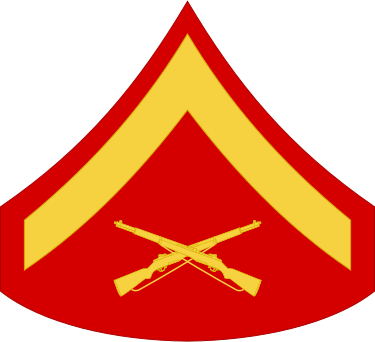


“Every Marine a rifleman. Every chevron earned.”
Navy
23 paygradesSR to ADM. Crows, anchors, gold stripes, and the Chief Mess running the boat from the deckplate.
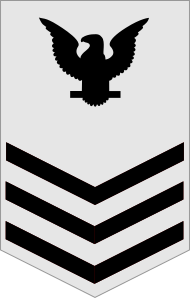

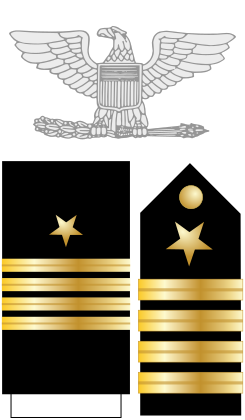
“Ask the Chief.”
Coast Guard
22 paygradesSR to ADM. Smallest armed service, multi-mission rotation, lifesavers in orange hulls.
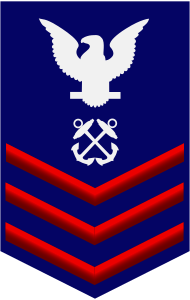
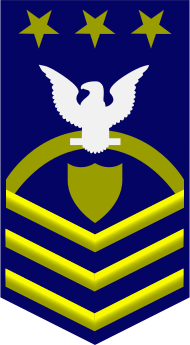
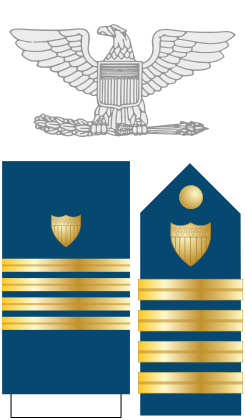
“Semper Paratus — and on watch when you sleep.”
Air Force
19 paygradesAB to Gen. Stripes that earn you AC, AFSCs that define your career, and the lowest-stress chow halls in DoD.



“No warrants. No drama (allegedly).”
Space Force
19 paygradesSpc1 to Gen. The newest branch with the strangest enlisted titles and the smallest formations in DoD.
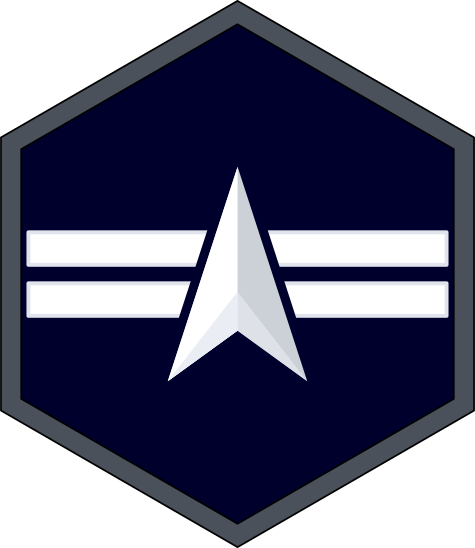
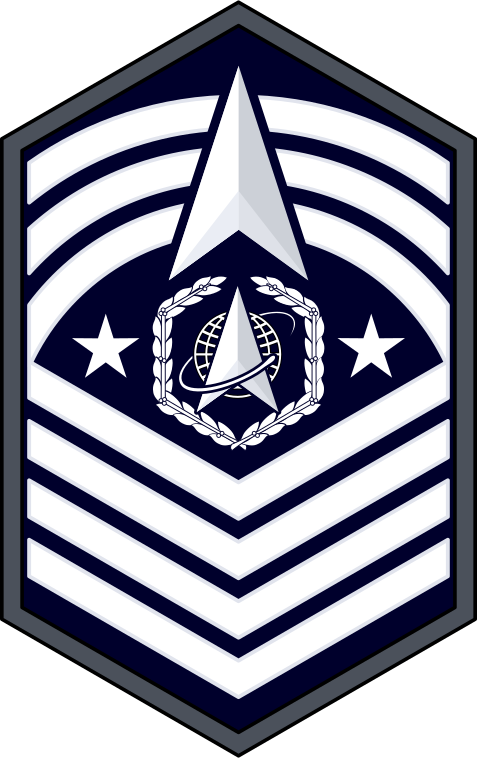

“Specialist 1-4. Yes, all of them.”
The rank chart is the easy half.
Every recruiting brochure has a rank ladder. They are accurate. They are also useless on their own: they will not tell you what an E-4 actually does on a Tuesday, why a Marine SSgt and an Army SSG have different cultural weight, why the Chief Mess runs Navy ships, what an Air Force SrA does after promotion, or why making Chief Warrant Officer is a different kind of promotion than making First Sergeant.
Each branch page covers the same skeleton: every paygrade with DFAS 2026 pay, time-in-grade minimums from the service’s personnel manual, the insignia (with images), the on-paper regulation language, and the off-the-record reality. Then the culture sections: the warfare communities, the senior enlisted institutions, the promotion bottlenecks, the special pays that change the math. Then a FAQ.
Pick your branch above. If you read all six, you will understand the U.S. military rank system better than 90% of the people wearing the uniform.
Common questions about military ranks
Are military ranks the same across branches?
The paygrade is the same — an E-5 in the Army, Navy, Marines, Coast Guard, Air Force, and Space Force all earn the same DFAS base pay at the same time-in-service. The rank title is not: an E-5 is a Sergeant in the Army and Marines, a Petty Officer Second Class in the Navy and Coast Guard, a Staff Sergeant in the Air Force, and a Sergeant in the Space Force. The insignia, time-in-grade rules, and selection mechanics also vary by service.
What is the difference between rank and pay grade?
Pay grade is the joint, DoD-wide code (E-1 through E-9, W-1 through W-5, O-1 through O-10) used by DFAS to write the check. Rank is the service-specific title attached to that pay grade — Sergeant, Petty Officer, Staff Sergeant, Lieutenant, Captain, Commander, etc. Every service member has one pay grade and one rank, and they are always paired.
Which branch has the most rank tiers?
The Army has the broadest ladder: 9 enlisted grades, 5 warrant officer grades (W-1 through W-5), and 10 commissioned grades, plus the wartime General of the Army (O-11). The Marines and Coast Guard also use warrant officers (CG limits W-1 and W-5; Marines uses W-1 through W-5). The Navy uses CWO2-CWO5 (no W-1). The Air Force and Space Force have no warrant officer program.
Are Air Force and Space Force ranks the same?
Officers: yes — both services use Second Lieutenant through General with identical insignia. Enlisted: no — the Space Force renamed the lower enlisted grades to Specialist 1 (E-1), Specialist 2 (E-2), Specialist 3 (E-3), Specialist 4 (E-4), then Sergeant (E-5), Technical Sergeant (E-6), Master Sergeant (E-7), Senior Master Sergeant (E-8), Chief Master Sergeant (E-9), and Chief Master Sergeant of the Space Force (single billet). The Air Force kept Airman, Senior Airman, and the Sergeant ladder unchanged.
What is the highest enlisted rank?
E-9 across all services, but each branch has a single-billet senior enlisted advisor at that grade: SMA (Sergeant Major of the Army), SgtMajMC (Sergeant Major of the Marine Corps), MCPON (Master Chief Petty Officer of the Navy), MCPOCG (Master Chief Petty Officer of the Coast Guard), CMSAF (Chief Master Sergeant of the Air Force), and CMSSF (Chief Master Sergeant of the Space Force). These are the senior enlisted advisors to each service chief and to the Secretaries.
Does pay change at the same time-in-service across branches?
Yes for base pay — the DFAS base pay table is uniform across all six armed services (Title 37 USC). Differences in take-home pay come from BAH (location-based), branch-specific special pays (sea pay, flight pay, sub pay, jump pay, dive pay), and re-enlistment bonuses, which vary by rating, MOS, AFSC, and retention quota.