What is the highest rank in the Air Force?
The highest rank in the Air Force is General (O-10), a four-star general officer. There are approximately 12 active-duty four-star Air Force generals at any time, including the Chief of Staff of the Air Force (CSAF), who is a member of the Joint Chiefs of Staff. The highest enlisted rank is Chief Master Sergeant of the Air Force (CMSAF), a single billet held by one person at a time who serves as the senior enlisted advisor to the CSAF and the Secretary of the Air Force.
What is the difference between Senior Airman and Staff Sergeant?
Senior Airman (E-4) and Staff Sergeant (E-5) are both junior enlisted-side ranks but the gap between them is the most consequential one in an Air Force enlisted career. Senior Airman is the top junior enlisted rank — promotion is largely automatic at 36 months time-in-service (or 28 months via Below-the-Zone), and you wear three stripes with a star. Staff Sergeant is the first non-commissioned officer (NCO) rank, requires passing the Weighted Airman Promotion System (WAPS) test, attendance at Airman Leadership School (ALS), and competition against your peer year group. Pinning Staff Sergeant adds a fourth stripe and changes how the Air Force treats you — you can write performance evaluations, supervise subordinates, and represent the NCO corps. The average time to reach Staff Sergeant is around 5 years; some career fields take 7+ years due to slow promotion timing.
What ranks does the Space Force have?
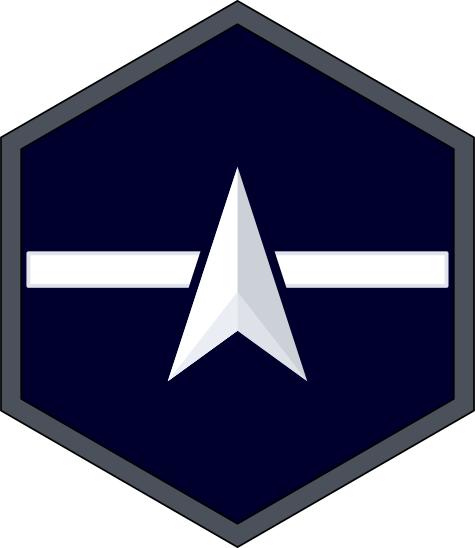
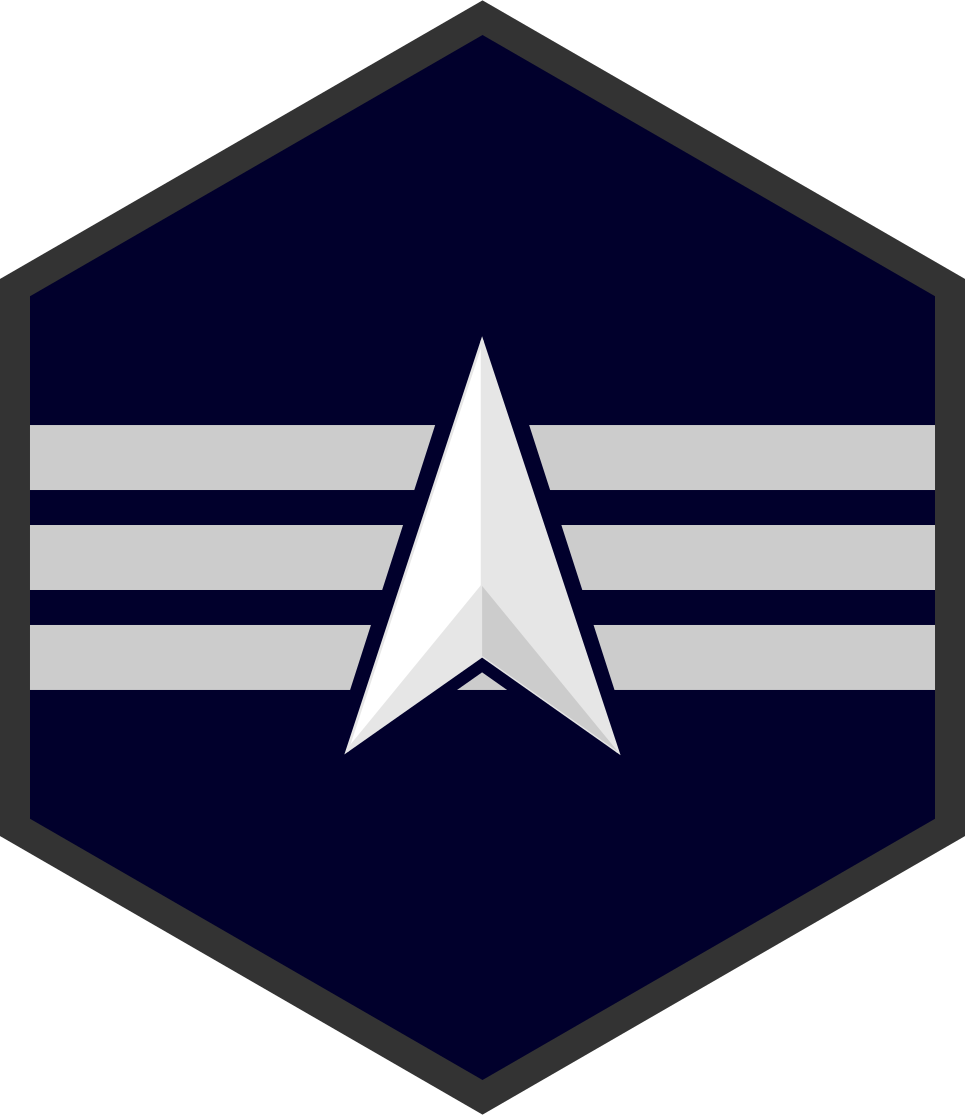
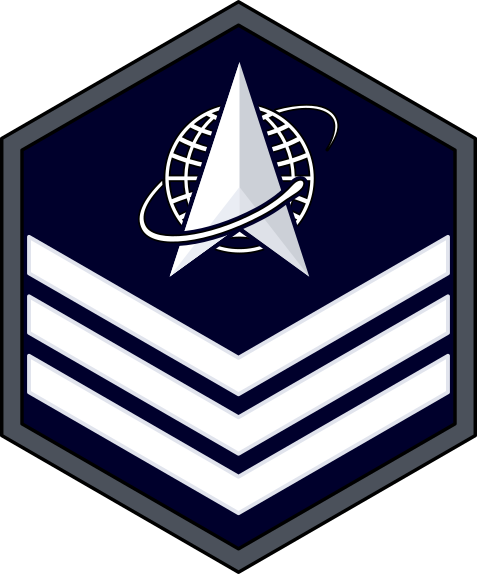
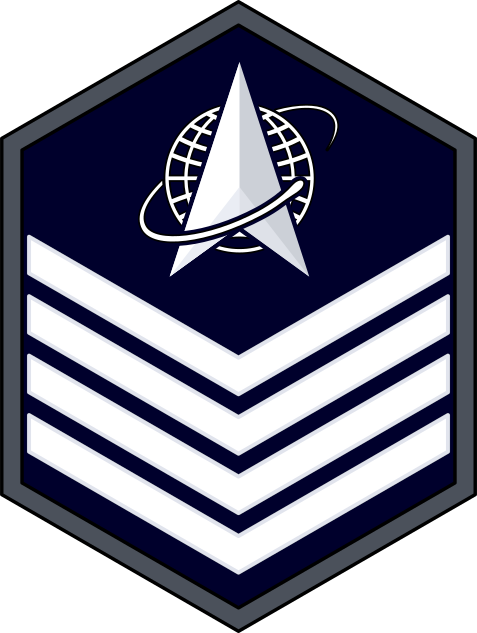
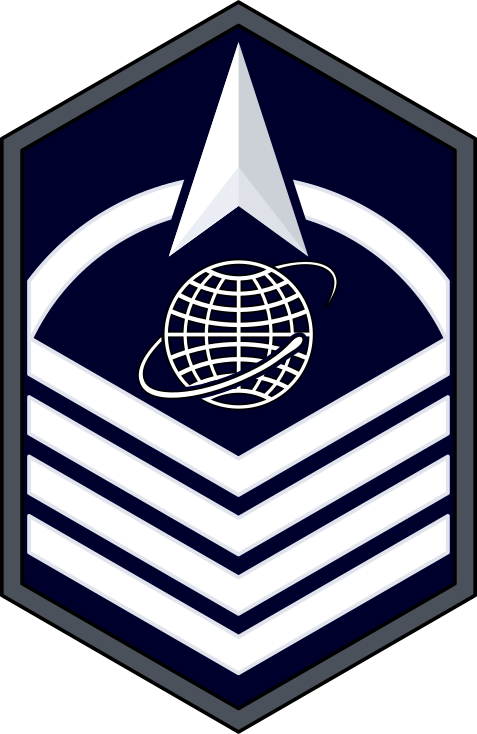
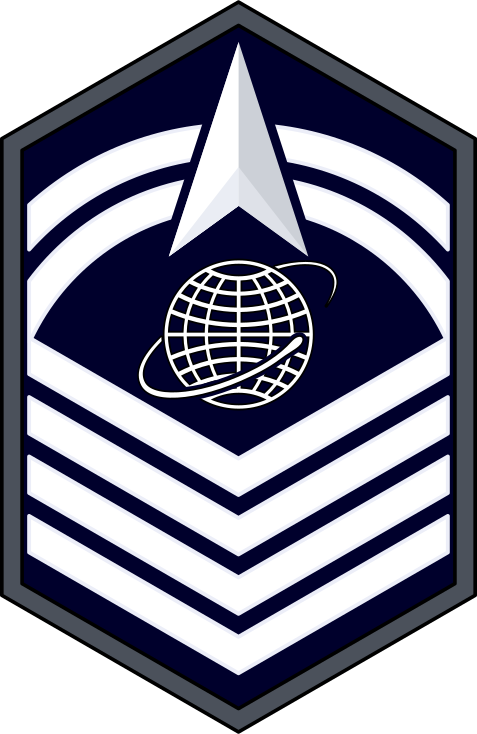
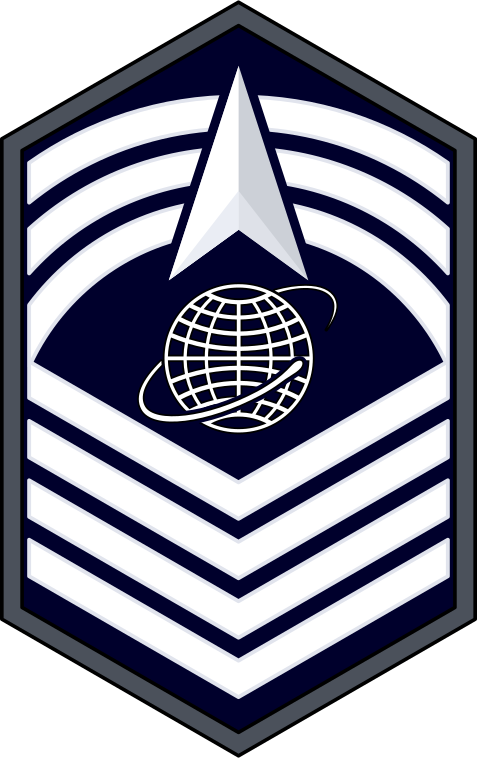
The Space Force enlisted ranks (E-1 through E-9) are: Specialist 1, Specialist 2, Specialist 3, Specialist 4, Sergeant, Technical Sergeant, Master Sergeant, Senior Master Sergeant, and Chief Master Sergeant. The top enlisted billet is Chief Master Sergeant of the Space Force (CMSSF). Officer ranks (O-1 through O-10) are identical to the Air Force: Second Lieutenant, First Lieutenant, Captain, Major, Lieutenant Colonel, Colonel, Brigadier General, Major General, Lieutenant General, and General. The top officer position is the Chief of Space Operations (CSO), a four-star general who is a member of the Joint Chiefs of Staff.
Why did the Space Force rename their enlisted ranks?
In January 2021, the Space Force renamed its enlisted ranks (E-1 through E-4) from the Air Force model ("Airman Basic," "Airman," "Airman First Class," "Senior Airman") to a "Specialist" naming convention ("Specialist 1" through "Specialist 4"). The official rationale was to reflect a Space Force identity distinct from the Air Force and to signal that the Space Force is a smaller, more technically focused service. In February 2021, the Space Force also chose "Guardians" as the official name for its members — controversial at the time, both because of the Marvel "Guardians of the Galaxy" association and because many service members felt the term was unserious. The renaming has not always been embraced internally. Many Guardians still refer to themselves by their job (operator, watch officer, satellite operator) or simply as "in the Space Force" rather than as a Guardian.
How long does it take to make Technical Sergeant in the Air Force?
Promotion to Technical Sergeant (E-6) is one of the slowest E-side promotions in the Department of Defense. The minimum eligibility is 5 years time-in-service and 23 months time-in-grade as Staff Sergeant, but the realistic average is much longer. Air Force E-6 average time-in-service hovers around 11 years across the force, though specific career fields (AFSCs) vary widely. High-demand technical AFSCs and lower-density career fields can sometimes pin TSgt around 8-9 years. Slow-promoting career fields like security forces, maintenance support, and some operational specialties can take 14+ years. Selection is determined by the Weighted Airman Promotion System (WAPS), which combines test scores (PFE and SKT), performance evaluations, decorations, and time-in-grade/time-in-service points.
Is the Space Force easier than the Air Force?
The framing is misleading — Space Force is not "easier" than Air Force, it is structurally different. Space Force operations are predominantly desk and console work: managing satellites, missile warning, GPS, space domain awareness, and orbital launches. There is no equivalent of an Air Force expeditionary deployment in the traditional sense — Guardians do not typically deploy to combat zones the way airmen do. However, watch officer shift work is mentally taxing (24/7 operations, rotating shifts, sustained vigilance on consequential systems), the security clearance requirements are among the highest in the DoD, and the work itself is technically demanding. Physical fitness standards exist but are less central to daily life than in the Army or Marines. The Space Force is also a very small service (under 10,000 active Guardians), which means assignment options are limited, careers are more visible to leadership, and there is less margin for poor performance.
Do Space Force and Air Force have the same pay?
Yes. Both services use the standard Department of Defense military pay tables published by the Defense Finance and Accounting Service (DFAS). A Specialist 3 (Space Force E-3) and an Airman First Class (Air Force E-3) at the same time-in-service make the same base pay. Special and incentive pays differ by job — Air Force aviation incentive pay (flight pay), for example, applies to rated officers and aircrew, while Space Force has its own categories of special pay for certain mission qualifications. Both services receive Basic Allowance for Housing (BAH) based on duty location and dependency status using the same DoD-wide BAH tables.
What is the Chief Master Sergeant of the Air Force?
The Chief Master Sergeant of the Air Force (CMSAF) is the senior-most enlisted member of the United States Air Force and a single-billet position. There is only one CMSAF at a time, appointed by the Chief of Staff of the Air Force (CSAF) and confirmed in the role to serve as the principal advisor on enlisted matters to the CSAF and the Secretary of the Air Force. The CMSAF wears a unique insignia (the standard Chief Master Sergeant chevrons with the Air Force coat of arms in the center) and represents over 250,000 enlisted airmen. Since the position was established in 1967, only 20 individuals have served as CMSAF.
What is the Chief of Space Operations?
The Chief of Space Operations (CSO) is the senior-most officer in the United States Space Force, a four-star general, and a statutory member of the Joint Chiefs of Staff. The CSO serves as the principal military advisor to the Secretary of the Air Force on Space Force matters and represents the Space Force on the Joint Chiefs. The Space Force was established by the National Defense Authorization Act for Fiscal Year 2020 (signed December 20, 2019), making it the first new branch of the U.S. armed forces since the Air Force was established in 1947. The current CSO is General B. Chance Saltzman, who assumed the position in November 2022 after the inaugural CSO General John W. "Jay" Raymond.
Why is Air Force enlisted promotion so slow?
Air Force enlisted promotion is structurally slow because of three factors. First, the Air Force has the highest retention rates among the DoD services — when more airmen stay in past their first enlistment, fewer slots open up at each higher rank, slowing everyone else. Second, the Weighted Airman Promotion System (WAPS) is heavily formulaic, which means even high performers can be blocked by time-in-grade and time-in-service point ceilings. Third, the Air Force has a smaller proportion of senior enlisted billets per career field than the Army or Marines. A consequence: an Army E-6 may pin Staff Sergeant in 4-6 years, while an Air Force E-6 (Technical Sergeant) typically pins around 11 years. This is documented across DoD-wide promotion timing reports and is one of the most common complaints about Air Force enlisted careers.
What is the difference between rated and non-rated officers?
In the Air Force, "rated" officers are those who hold an aeronautical rating — pilots, combat systems officers (CSOs), air battle managers, RPA pilots, and flight surgeons. "Non-rated" officers are everyone else — intelligence, cyber, acquisitions, logistics, security forces officers, and the like. The rated/non-rated divide is the dominant social structure in the Air Force officer corps. Rated officers historically have promoted to general officer at significantly higher rates, occupy most senior wing and major command positions, and form a distinct career community with their own development paths (training squadrons, instructor pilot tracks, weapons school). Non-rated officers often describe a "glass ceiling" — competent non-rated officers can make Colonel, but the path from there to General is significantly steeper than for rated peers. The Space Force does not have this divide, which is one structural reason some Air Force officers transferred over in 2020-2021.
What does AFSC mean?
AFSC stands for Air Force Specialty Code — the system the Air Force uses to identify enlisted and officer job specialties. AFSCs are alphanumeric codes (e.g., 1N371 for a journeyman intelligence analyst, 11F3A for an experienced fighter pilot). The first digits indicate the broad career field, with subsequent digits indicating skill level (1=helper, 3=apprentice, 5=journeyman, 7=craftsman, 9=superintendent for enlisted; 1=entry, 3=qualified, 4=staff for officers). The Space Force uses a similar system called the Space Force Specialty Code (SFSC), although it has been periodically restructured since the service stood up. Your AFSC/SFSC determines your technical school, your career progression speed, your deployment patterns, and (often) your retention bonus eligibility.